
Quick review
The good
The not-so-good
After watching nearly every competitor enter foldable phones, Apple is ready with the iPhone Duo. Does it deliver on its potential and price?
Apple may well not be the first company to do every idea, but when it does one, it likes to get it right.
It didn’t have the first media player, but the iPod changed the world like no other media player of its kind. It didn’t make the first tablet, but the iPad has clearly made one of the biggest impacts on portable computing. And it didn’t make the first folding phone, but its first entrant in that category aims to make waves, or maybe just folds.
After a long wait and plenty of rumours, the iPhone Fold is here, known by its real name of the iPhone Duo. You might see that name as indicative of just how many screens it has — two — but it could also be from its uses: phone and tablet, all in one.
That’s the idea, and it’s one phone owners may have been hoping to see Apple play in for some time. After all, Samsung and Google and other players have been building gadgets like this for several years, with Apple quiet all throughout.
But now, roughly seven or eight years later from foldable beginning to make their way to the real world, Apple is here. Is the foldable iPhone Duo everything it’s cracked up to be? Is it a page worth folding over, or merely something Apple should scrunch it all up with tiny folds and start again?
Design
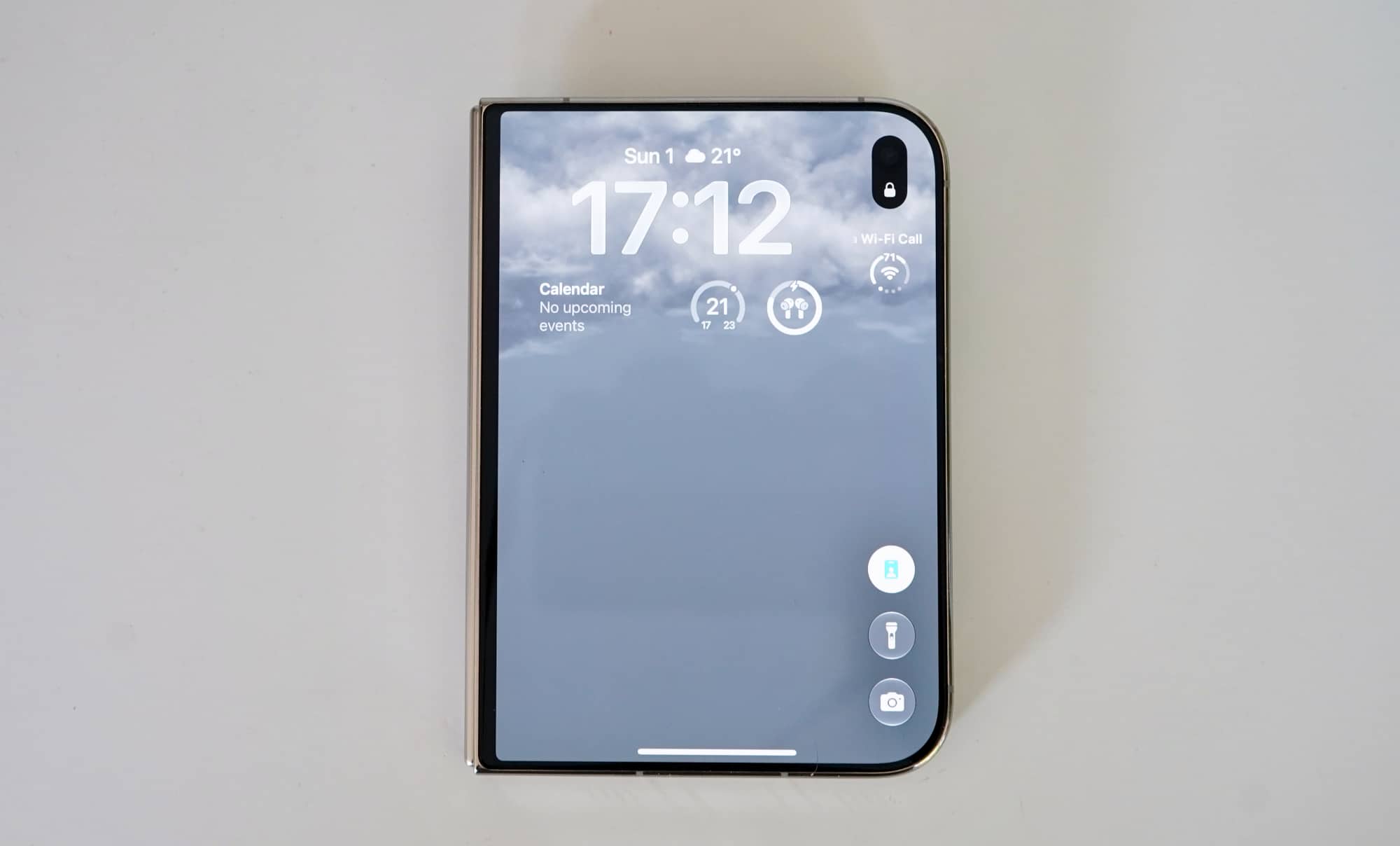
Apple may well be new to the world of folding phones, but you’d never realise it looking at the iPhone Duo. This thing looks about as polished as polished could be.
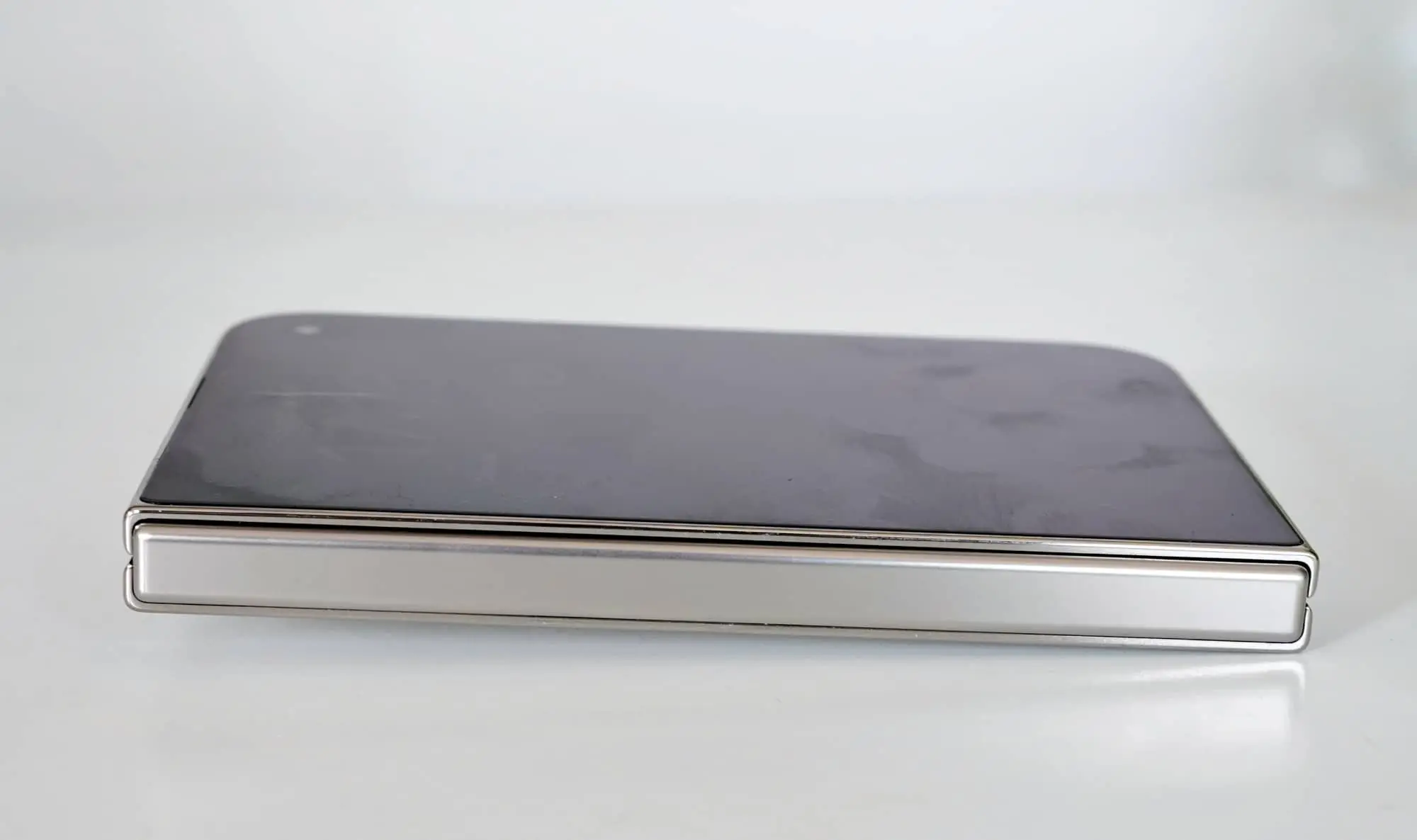
Designed with a metal frame that looks rather like the iPhone Air, the handset is made from titanium and glass, using Apple’s Ceramic Shield glass protection technology to give it that little bit more resistance than you might expect.
It’s 5.2mm slim when unfolded, just off the 5.1mm of the iPad Pro, while the thickness more than doubles when closed shut, matching 11.3mm once thrown in your pocket. In plain English, that’s thicker than the 8.75mm iPhone 17 Pro Max, but obviously thinner than your computer.
Yes, it’s still a little fragile, because here is a phone with a foldable screen. That’s not all that new in the Android camp, but over in Apple World, it’s very new, and glass is beginning to break easily in some instances. Do take care.
It does offer more than a hint of durability, something folding phones aren’t known for, set to IP68 for dust and water resistance, so you can see Apple has built this phone to be a little more hardy than the fragile fold you might have been expecting.
Features
Inside the Duo shares a lot in common with the other 18 models, devices that are basically the year’s best efforts for Apple, as every new generation under the hood typically is. That makes the inside of the Duo technically an iPhone 18 Pro and Pro Max, even if other features clearly aren’t the same.
Of the ones that are the same are the insides, offering this year’s iPhone processor of choice, the A20 Pro, delivering a six-core CPU and a seven-core GPU, plus a dual 16-core neural engine for AI processing.
Depending on how much you spend, there’s a choice of either 256GB, 512GB, 1TB, or 2TB storage, but much of the hardware is the same regardless.
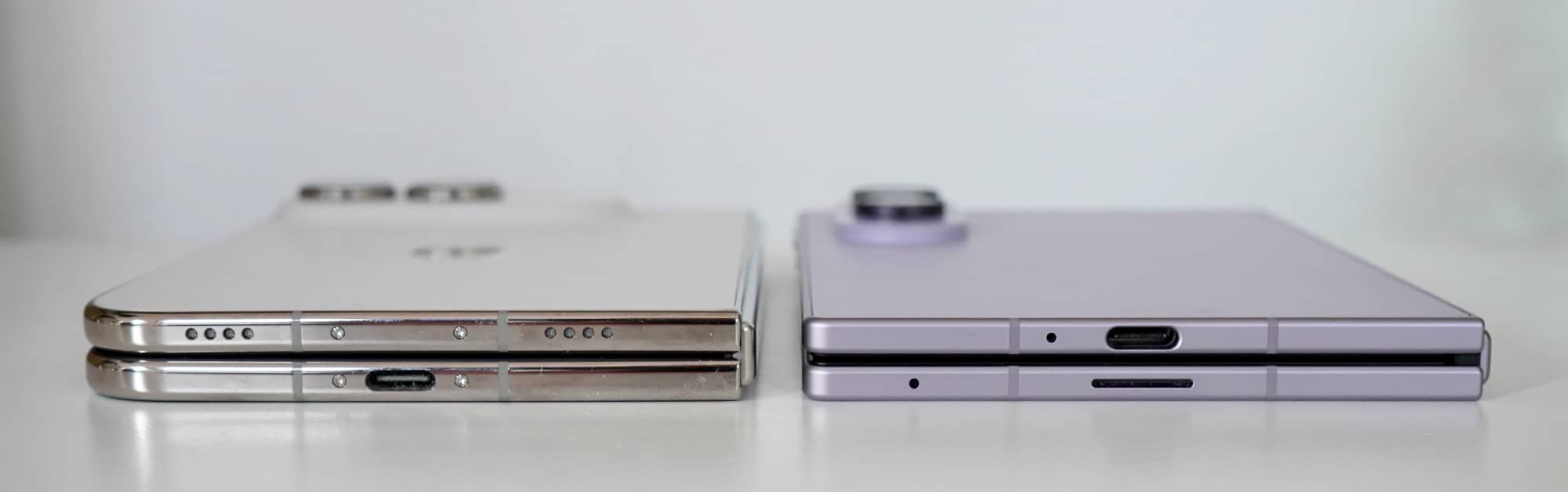
There’s Bluetooth 6, Wi-Fi 7, 5G over sub-6, and support for Near-Field Communication (NFC), Ultra-Wideband (UWB), GPS, emergency SOS with satellite, crash detection, and the smart home networking technology known as Thread. The one physical connection is a USB-C port at the bottom, supporting audio, charging, data via USB 3, and display via DisplayPort.
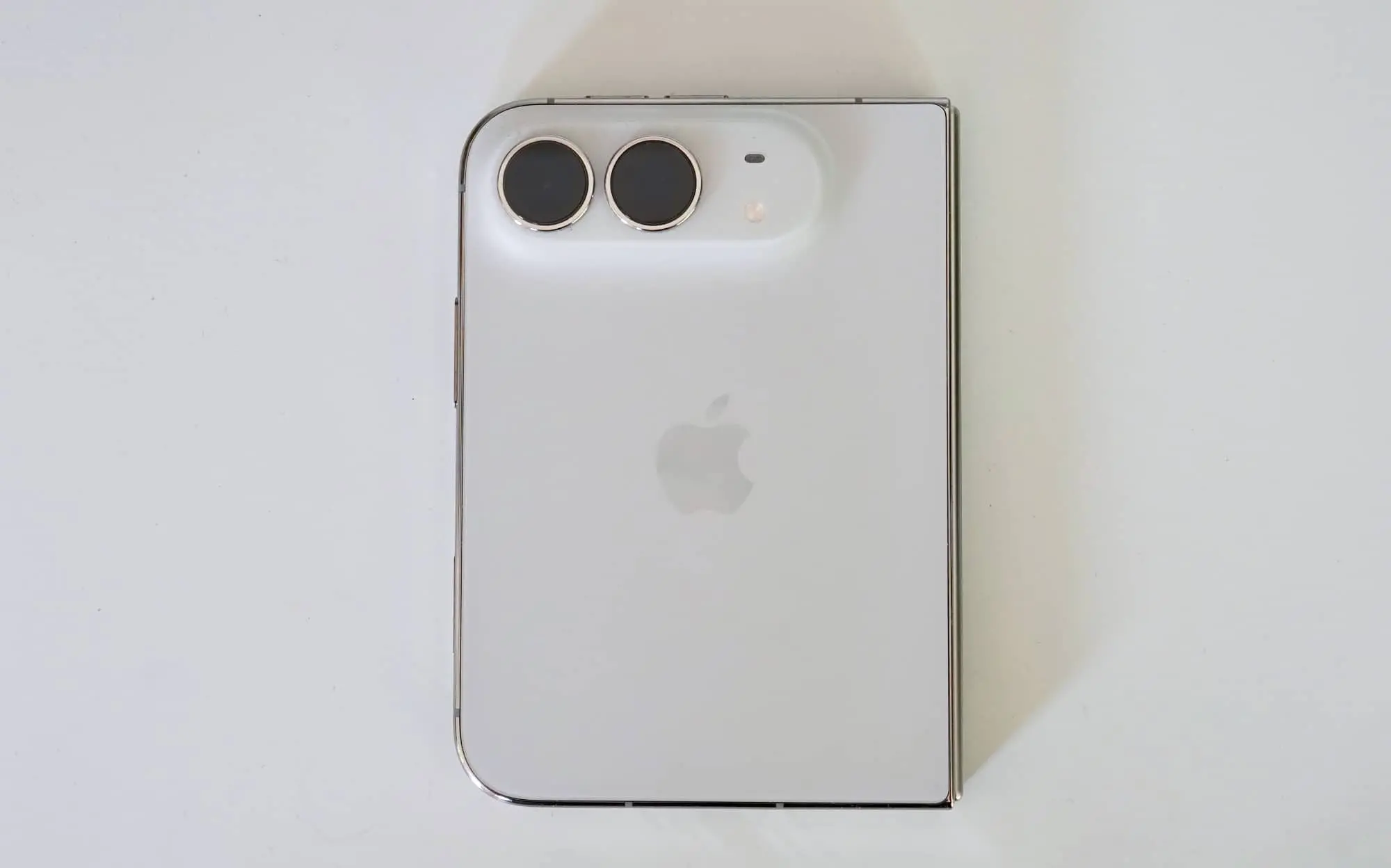
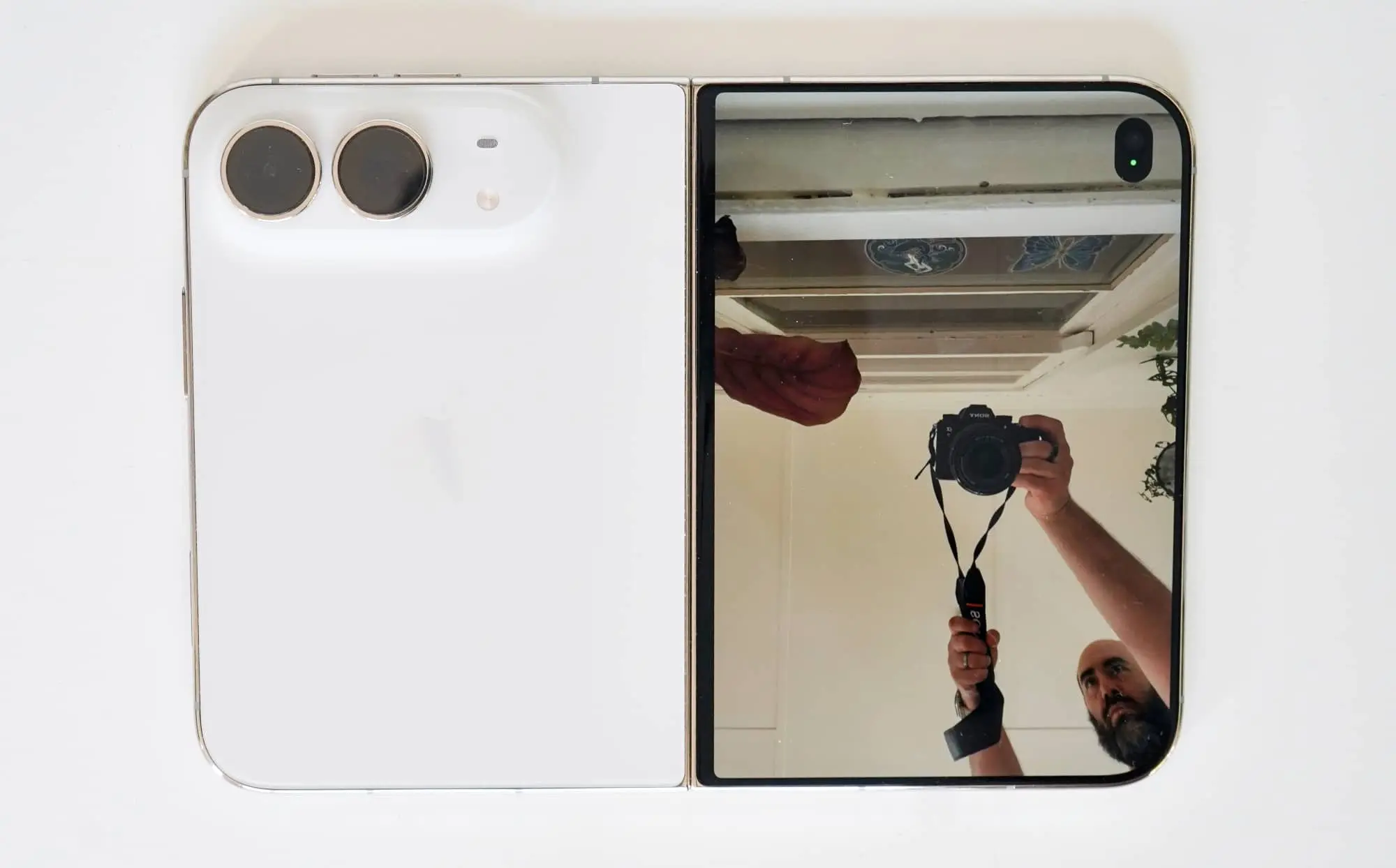
Several cameras can be found on the iPhone Duo, covering two 48 megapixel camera for F2.2 ultra-wide and F1.6 regular wide on the back, and two selfie cameras, too: a 12 megapixel Center Stage camera offering F2.2, while the inside provides an under-screen 4 megapixel FaceTime camera at F1.8.
The phone also features a fingerprint sensor under the power button, plus the camera haptic controller we’ve seen on a few iPhones before. There’s also support for MagSafe and Qi2, a feature folding phones tend to miss out on, save for the Google Pixel Folds.
Displays
Get past the inside and you can discover the outside, which is where two screens can be found, one on the outside and the other technically on the inside when you unfold it. The terminology can get a little messy from here, so stick with us.
Two displays are found on the fold: a 5.4 inch OLED screen with a resolution of 1398×2034 on the outside, and a 7.6 inch foldable OLED panel on the inside running a resolution of 1878×2670.
They’re both bright, but the outside screen is the one you’ll probably use most, and is basically like every other OLED screen Apple uses on phones. It’s sharp and visually stunning to look at, working with a 120Hz ProMotion refresh rate, and is basically like a current iPhone screen, but one where you’ll feel a third has been cut off. They both support the ProMotion high-speed screen tech, as well as support for the Apple Pencil, but only the USB-C model and only with an eventual update to iOS.
But the screens are that little bit different, and the front screen markedly so. It’s short, pudgy, but still surprisingly clear and easy to use and work from.
When you need a bigger display, you can open the phone up to reveal the real star of the show: the bigger tablet screen that works in both portrait and landscape, and feels like it packs a folding variation of the iPad Mini OLED screen into the body of an iPhone.
The crease
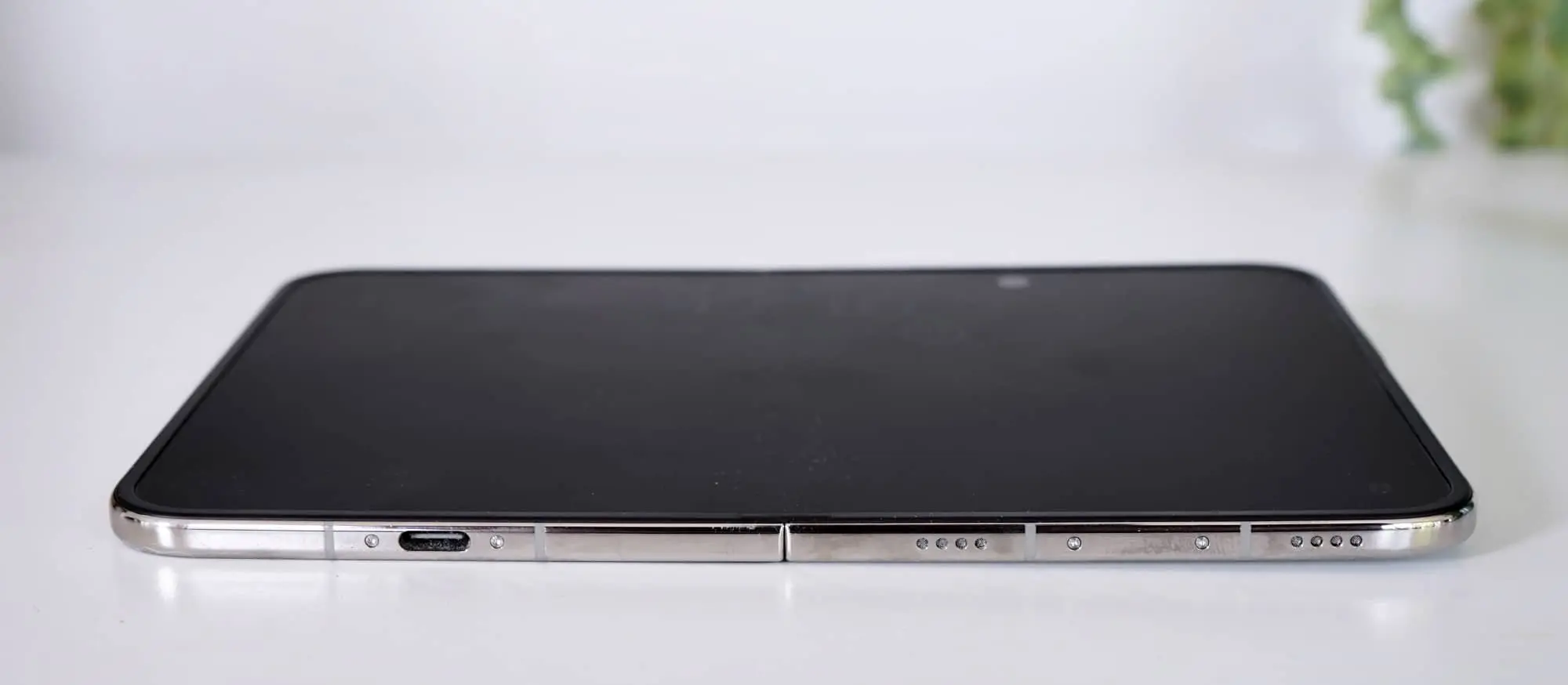
Easily one of the biggest question marks on the mind of any potential Duo owner is the crease. After all, foldables have long had the foldable crease as a major issue since they first arrived.
In the near-decade since they’ve been out, the crease has started to become less of an issue. It’s there, but you start to forget about it, as technology companies work out new ways to flatten it and remove it from the front of mind.
Oppo did great work with its Find N6 this year, and Samsung’s titanium-enhanced screens are tremendously interesting, as well.
Given that Samsung worked on the screens for Apple, we’re not terribly shocked to see a similarly near-invisible crease on the iPhone Duo, and you really need to look hard to find it.
However, Apple has one-upped the competition with an extra feature: a nano-texture finish that helps give the screen a matte look which pulls back on the crease even more.
The result is an effect that you really need to see to believe. The crease is there, but good luck finding it. Your finger might feel a subtle change before your eyes pick up on it, and it’s just so good, the screen may as well be flat. Your brain won’t likely be able to tell the difference.
It’s a great start.
Outside use

However, the use of the nano-texture does come with a bit of a caveat: outdoor use can be a little less easy to see.
Bright daylight and lots of sun can mean that an inside foldable tablet screen doesn’t always fare well with the outdoors, and may force you to close the Duo when the screen struggles to amp up the brightness.
It’s not a deal-breaker, truth be told; most phones struggle with severe brightness, and beyond boosting the nits incredibly, you have a solution from simply closing the phone shut and using the glossy screen on the front of the Duo.
In-use
Regardless of how you use the iPhone Duo, you’ll find a couple of ways to use it. Possibly more than two, even.
Foldables may well have been out for nearly a decade, but the concept is still so new that most people haven’t tried them. And that means using them (or getting used to them) can be a thing.
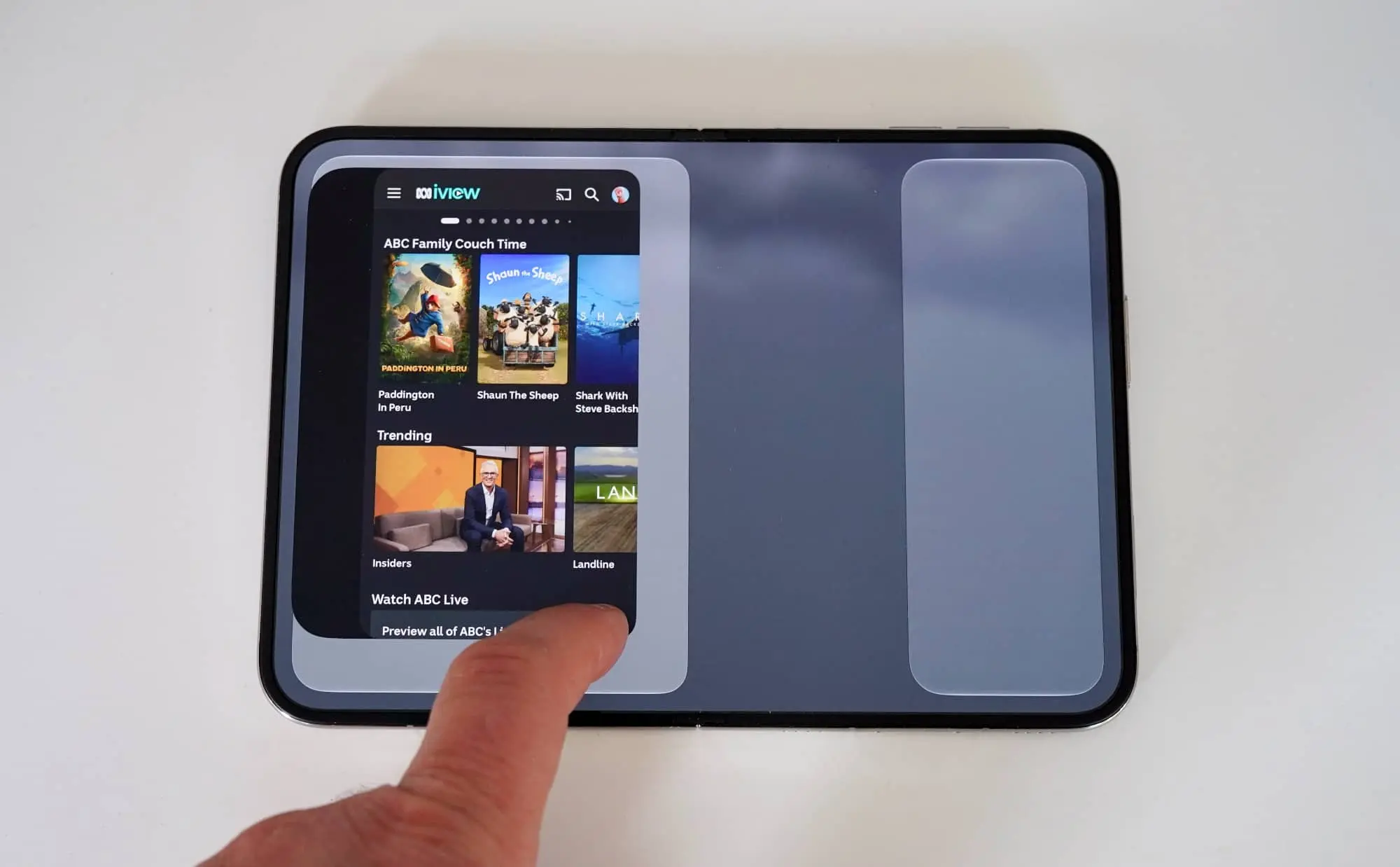
Here in the iPhone Duo, things are a little different from the way most iPhone users will recognise, but not substantially, because now you get two styles of devices with two screens.
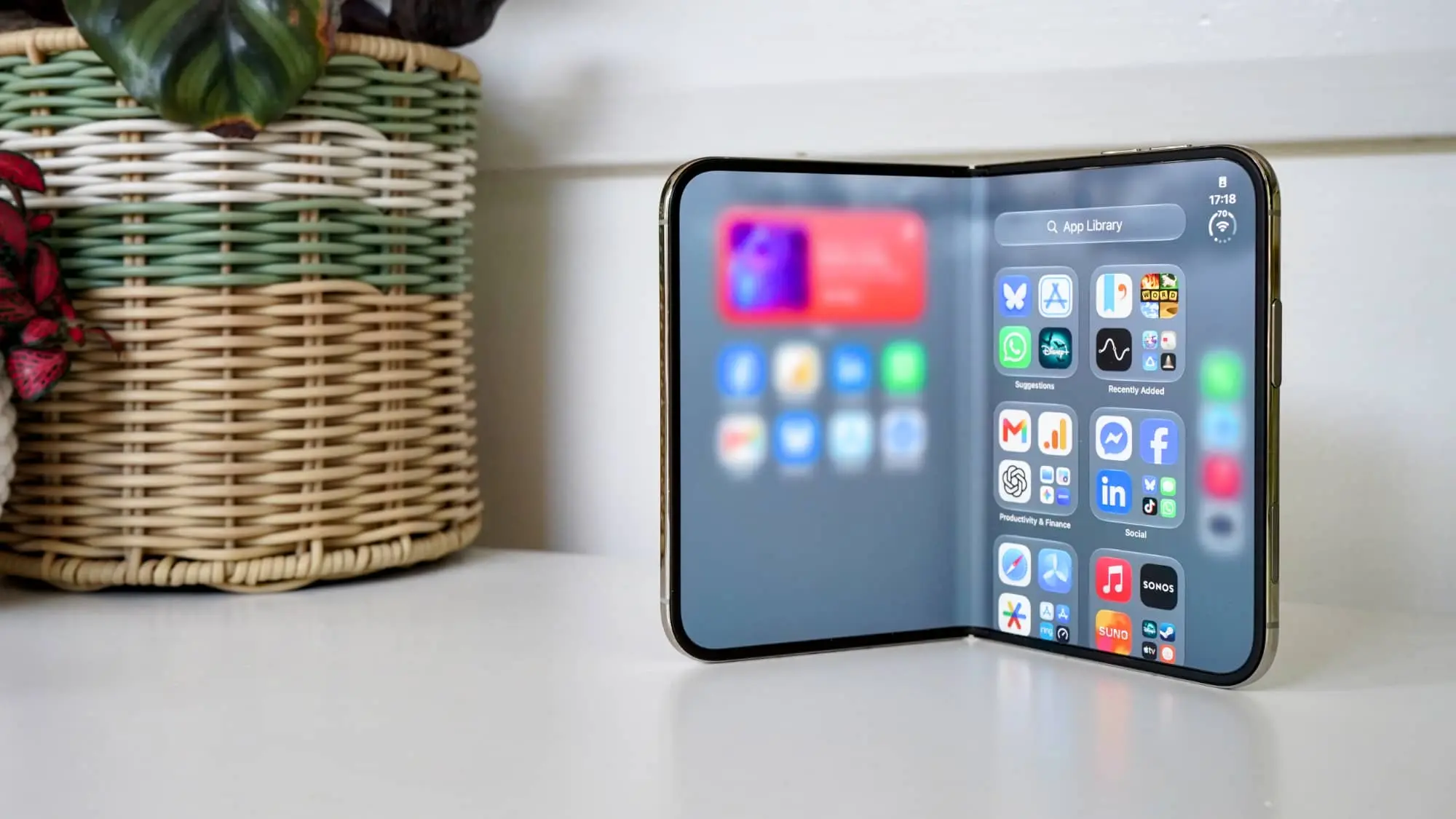
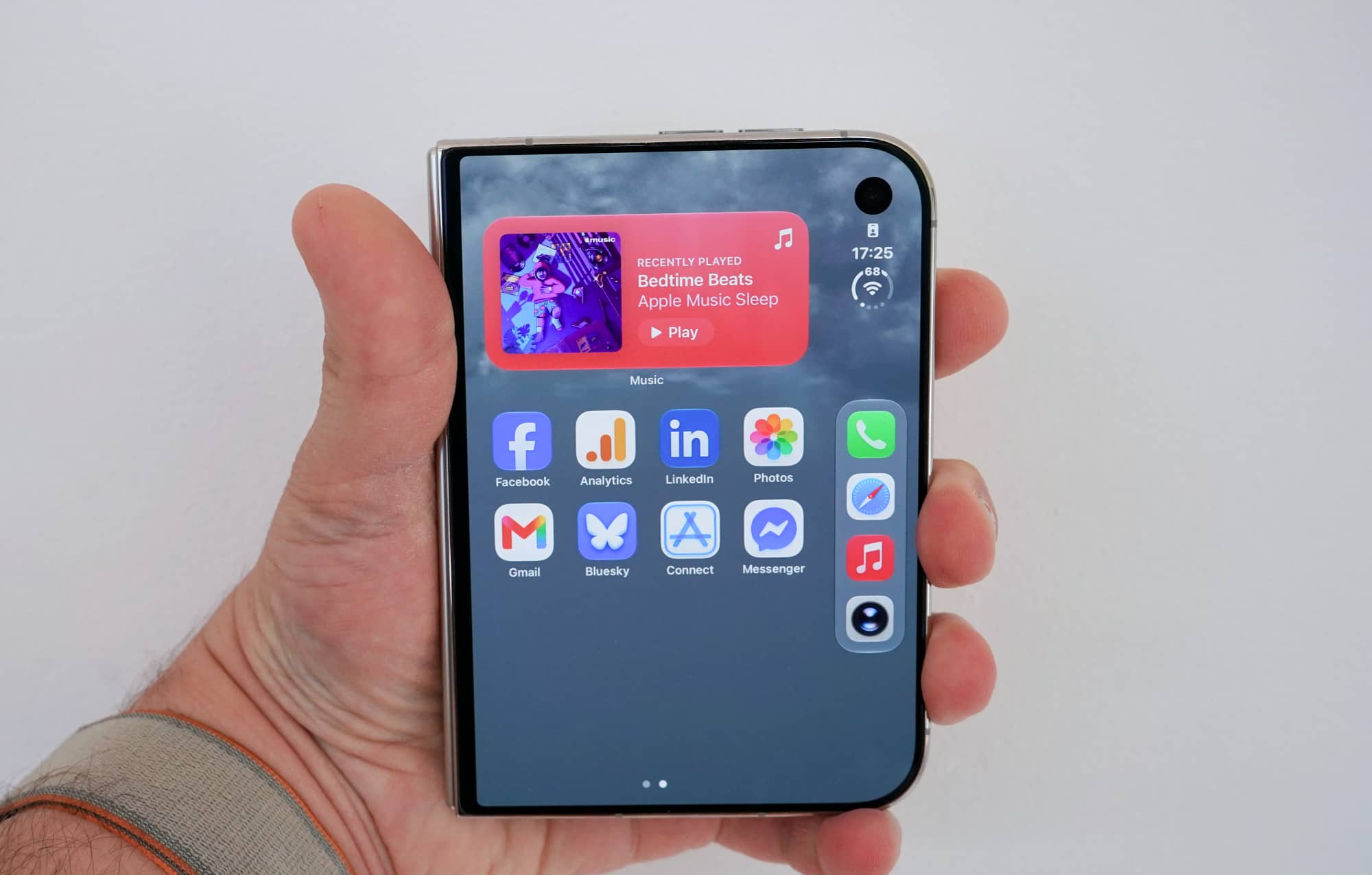
On the outside with the cover screen, it’s a smaller passport-styled device, closed and folded. And on the inside, it’s a larger, more tablet-styled device, open and unfolded.
Closed and folded
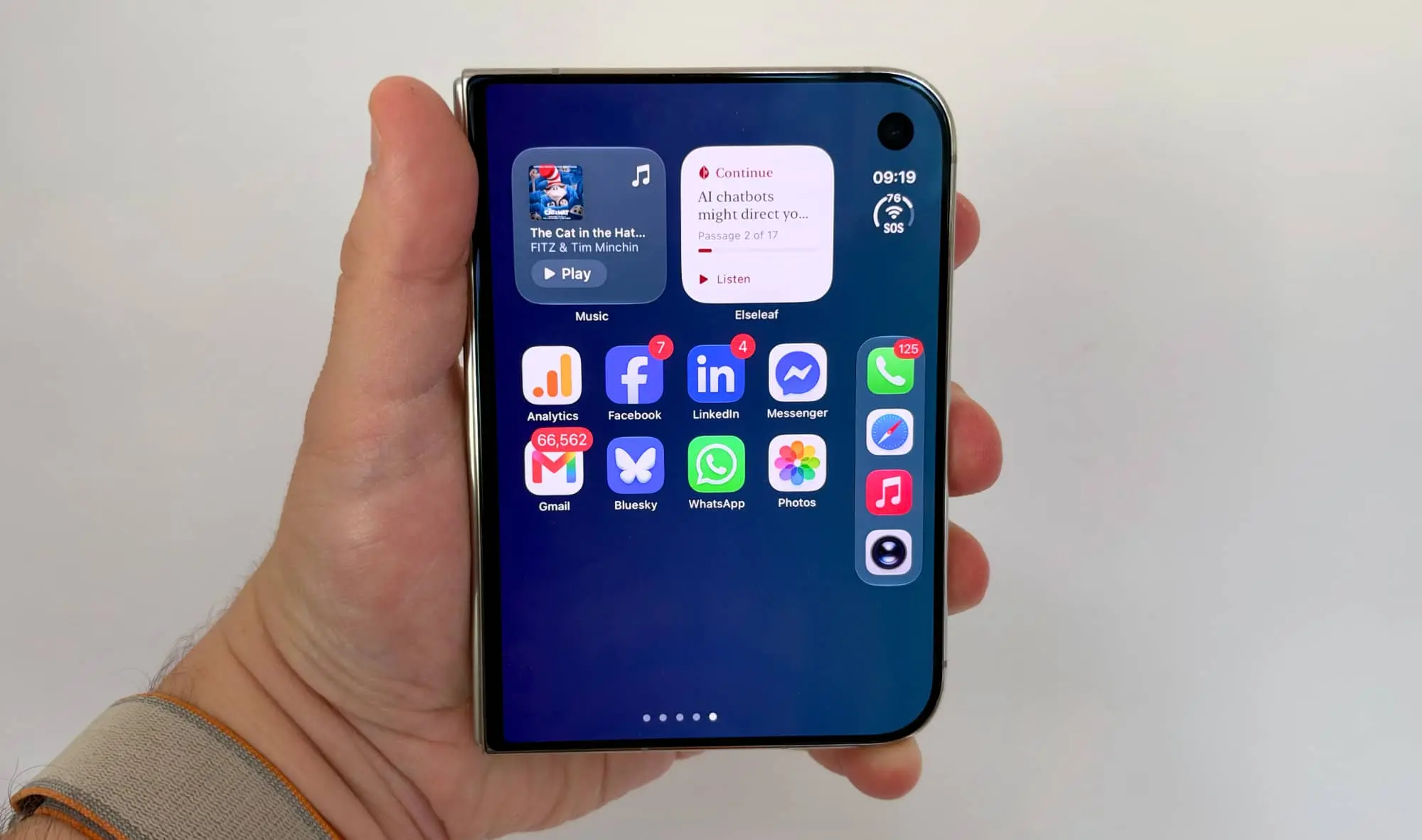
The way you’ll likely use the iPhone Duo more is in its closed configuration, whereby you pull the phone out and just start using it.
This is the closed and folded way of using the iPhone Duo, or more simply put, the normal way of using an iPhone. It’s a 5.4 inch screen facing you, which is rather near the 5.5 inch display on the iPhone 8 Plus all those years ago, just a little shorter and stubbier.
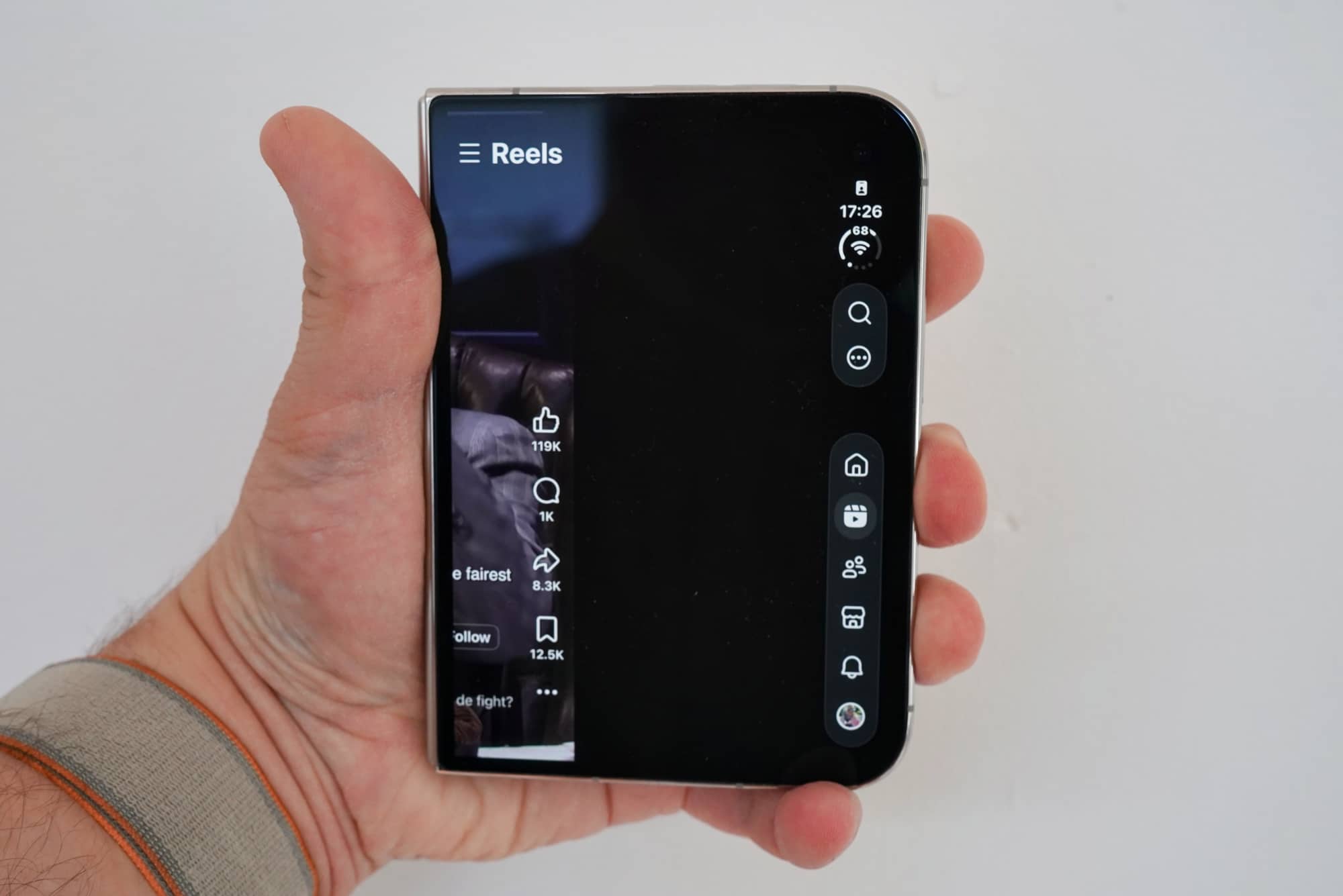
Your icons are actually on the right here, sitting in line with a column under the camera and changing the iOS interface a little, but it’s also largely the same as what you might have been used to. Swipe and gestures and everything you know, just in a shorter style.
Open and unfolded
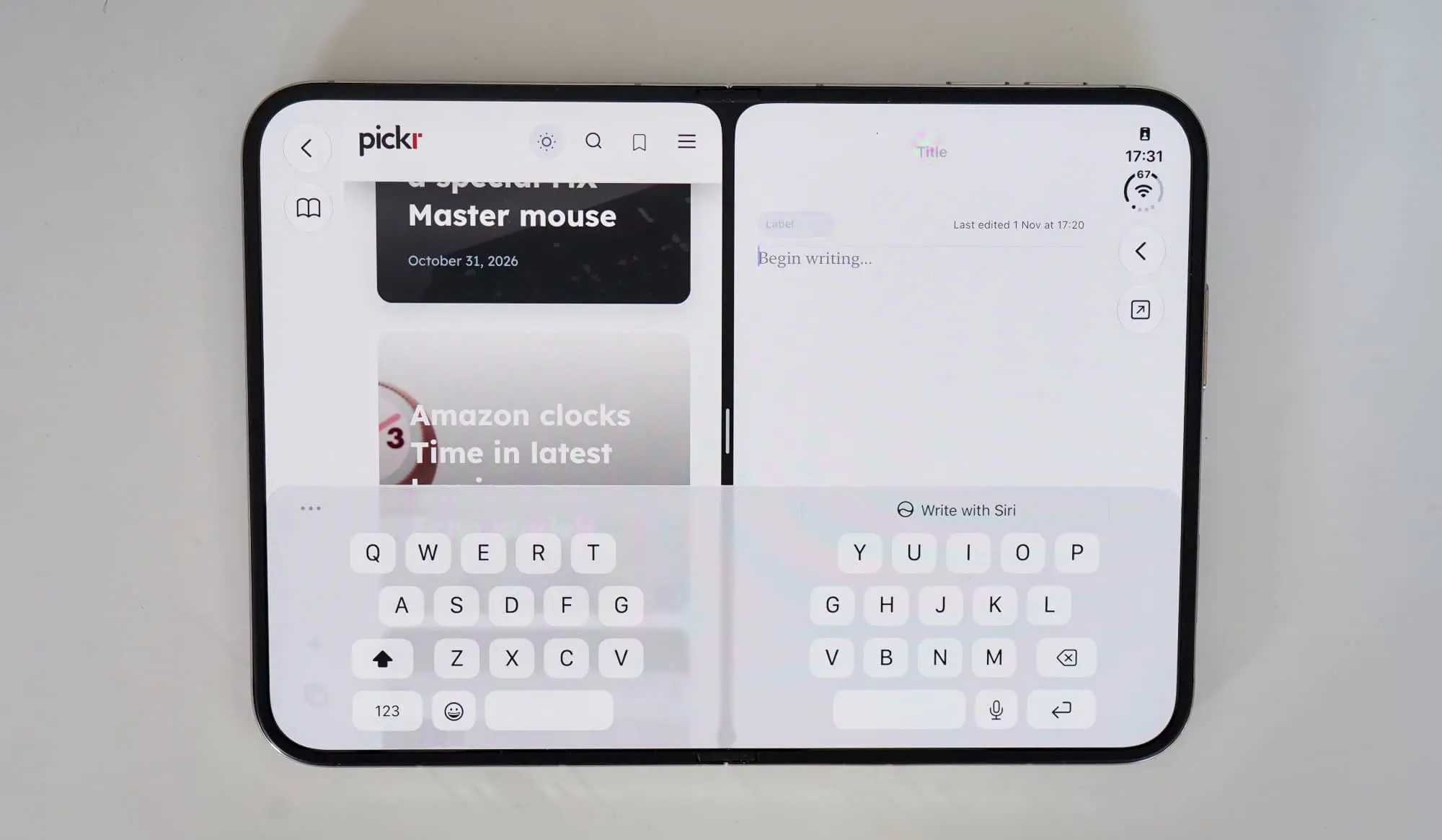
When you need more space, you can open the iPhone Duo for the larger tablet approach, which isn’t an iPad, but rather just iOS made to be bigger. We need to stress that: the iPhone Duo clearly isn’t an iPad, even if aspects of it can feel like one.
Open and unfolded, the iPhone Duo offers a 7.6 inch screen that’s fairly spacious, giving you the ability to browse sites with more space, read eBooks in a way more like a Kindle or iPad Mini, and even edit photos or other things like a compact tablet.
Depending on the app you’re using, you can also opt to take advantage of the hinge. In tablet mode, the Duo doesn’t have to work as a purely flat device like a tablet, but can work as other functions.
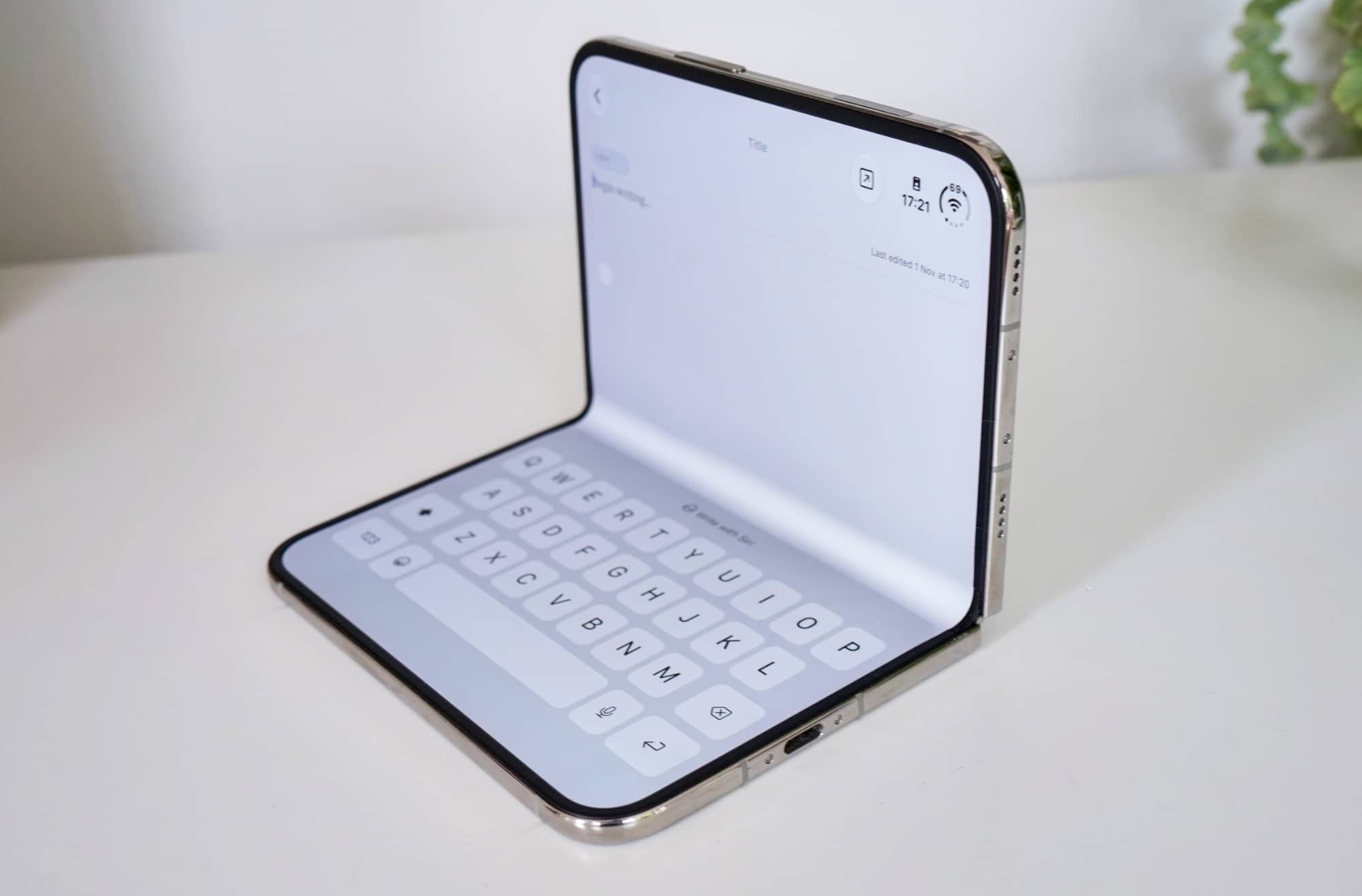
Angle the screen up and make it look like a laptop, and all of a sudden you can type on a compact bottom while using the screen. It’s a MacBook Nano!
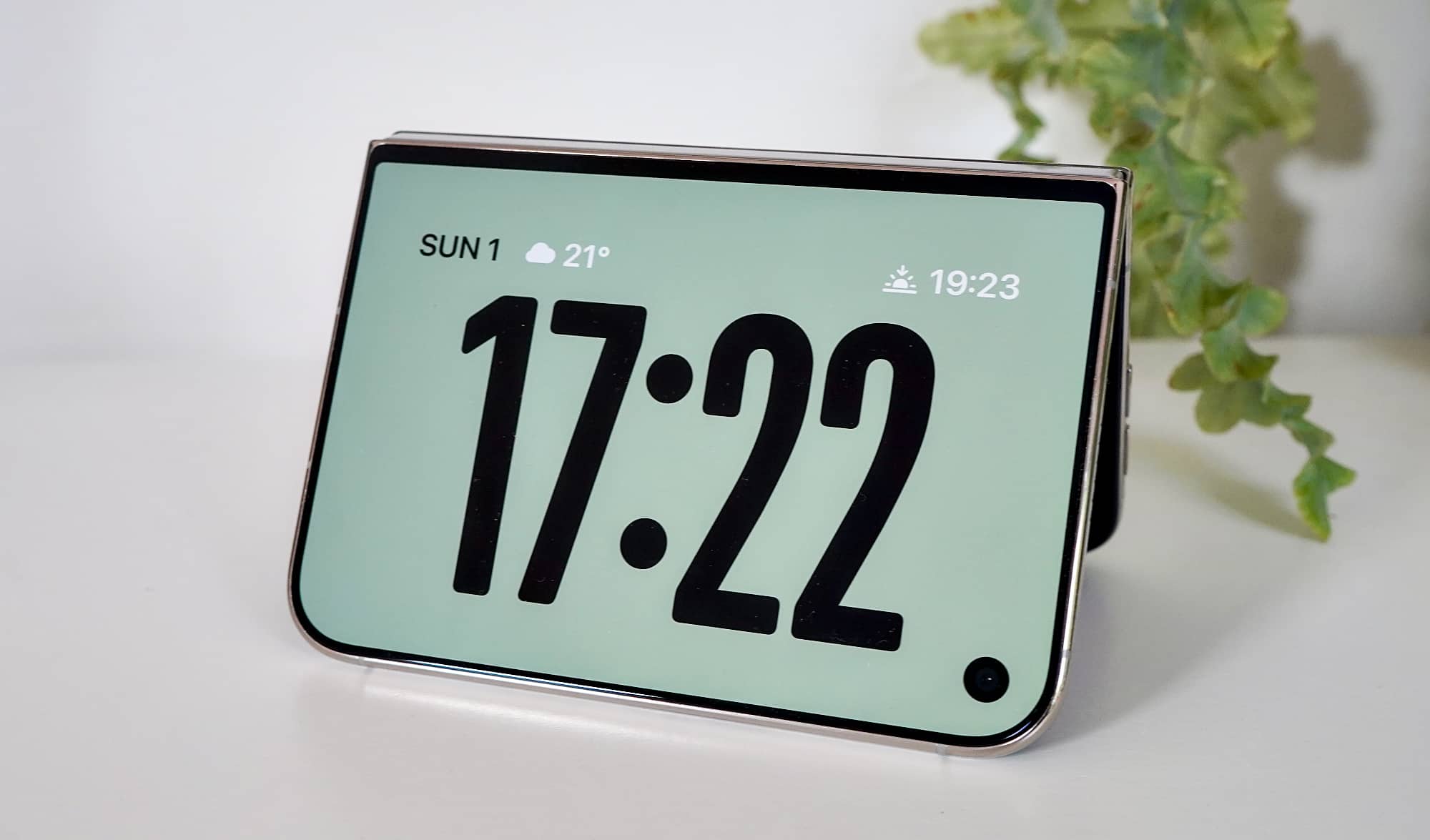
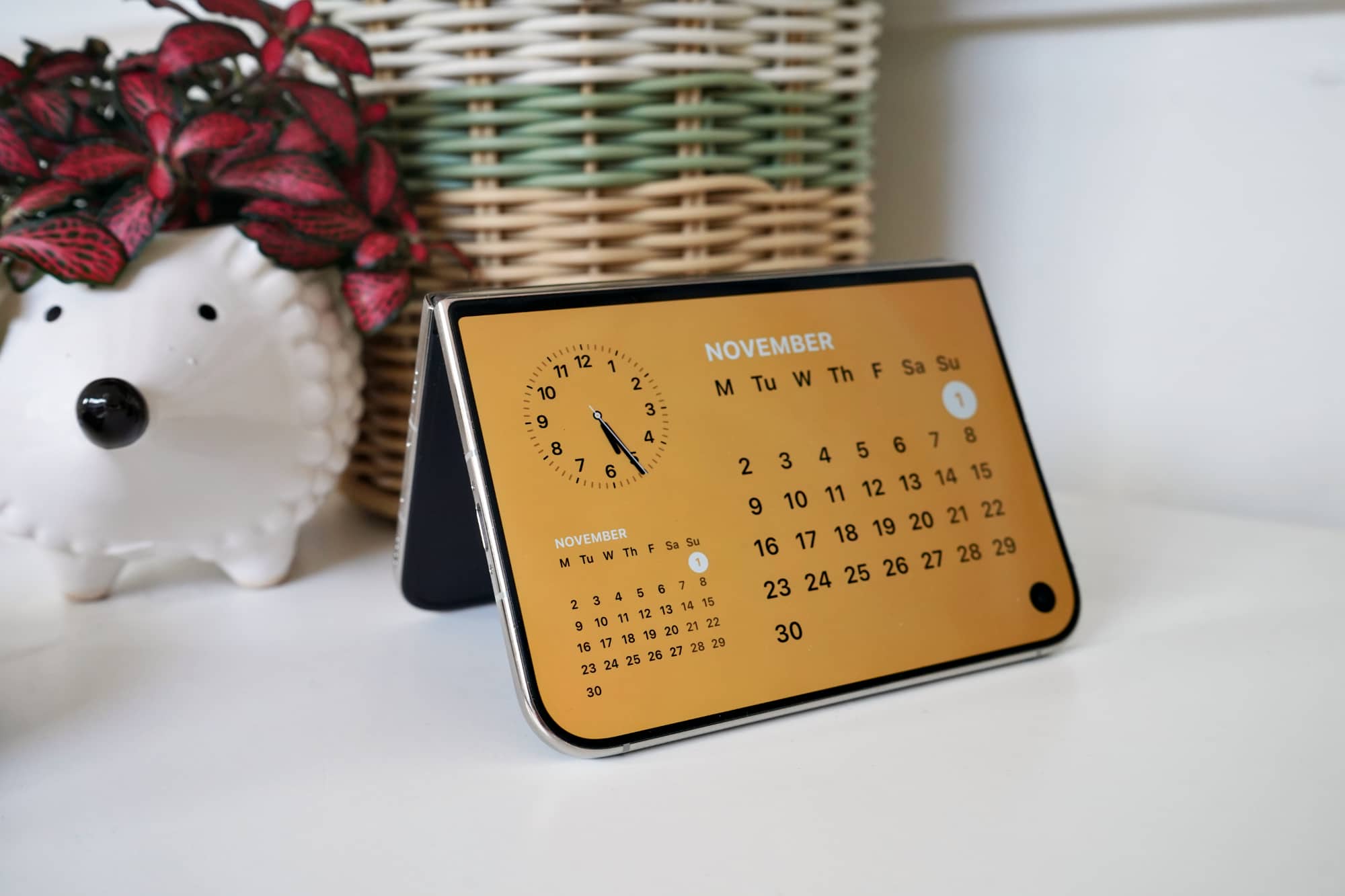
Almost close the Duo (but not completely) and then flip it over to look like a tent, and it becomes a compact desk clock, a desk calendar, a small photo stand, and so on.
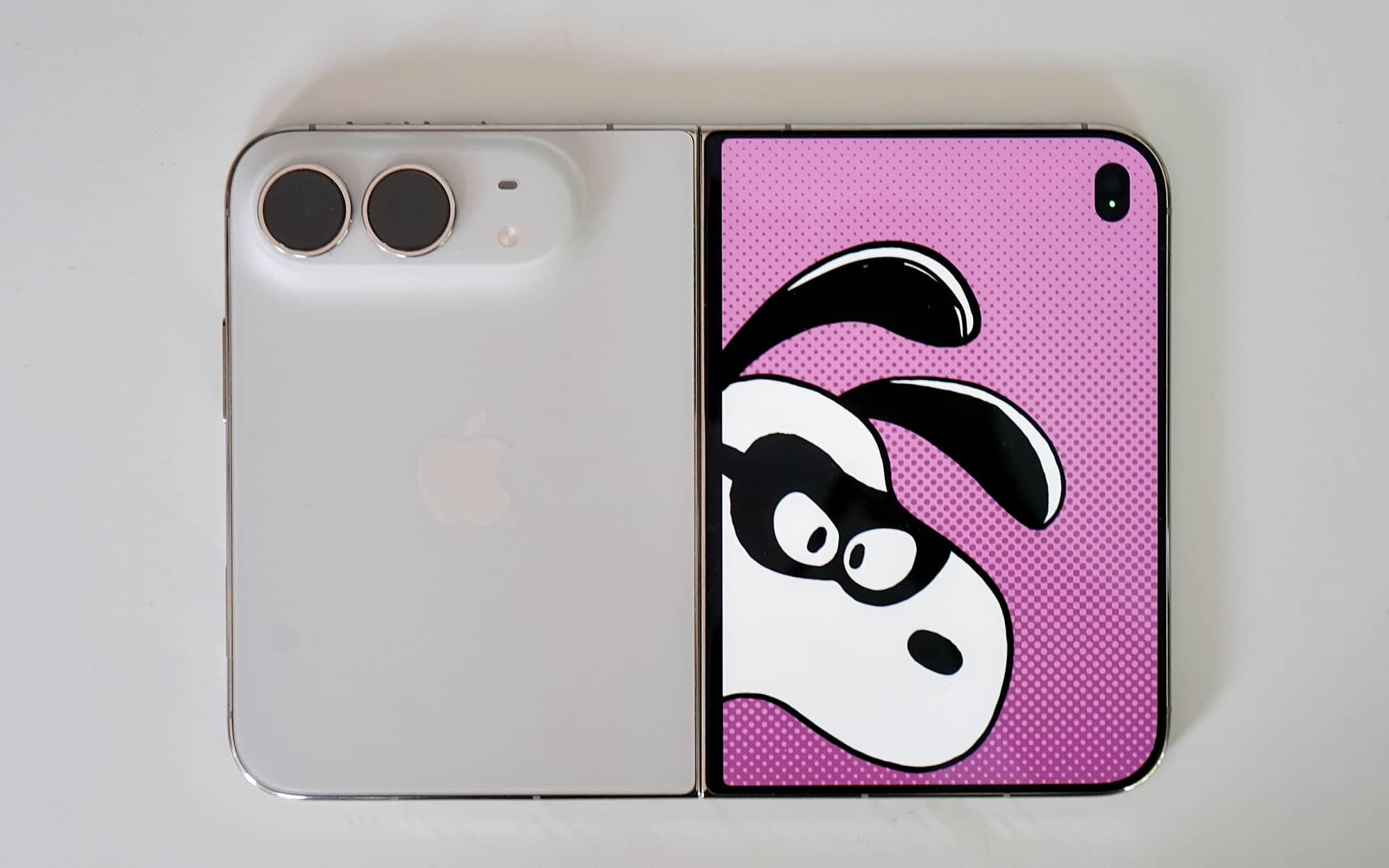
You can even opt to use the external cover screen at the same time for the camera, switching it on as a preview or triggering a family-friendly “kid” mode where Snoopy will arrive to make kids smile.
We first saw a similar concept like that with Motorola phones, but bringing Snoopy along for the ride is Apple using an Apple TV property beautifully. Like Buzz and Woody, Mickey, and Snoopy individually on the Apple Watch, it’s a genuinely clever integration.
App design
Most of the time, the rear screen stays off when in the open and unfolded book style of the iPhone Duo, and that’s the way it’s meant to be. But we definitely need to talk about the app design, because it’s one of the usability features Apple has considered, and in a way we’ve not seen on folding phones prior.
Rather than just make the iPhone Duo a really short or really wide iPhone, Apple has thought about the interface the extra screen real estate offers, and made changes to how its operating system works with all of that. This isn’t just an iPhone, and it’s technically not an iPad, so Apple needs a different way of making it work.
The difference between iOS design on a phone and tablet is to throw the dock to the side. Literally.
While both an iPhone and iPad use the bottom of the device to store important shortcuts — much like macOS does, as well — the iPhone Duo uses a spot on the side in both modes, effectively making use of the line under the camera on the front, and following it through when unfolded.
It’s an approach that makes apps that little bit more focused for this form-factor, and throws the shortcuts and controls to a specific place. Developers can choose to use it, but those that do get a more “Duo”-specific experience, and it makes sense.
It does come with a caveat, however, and it’s that symmetry doesn’t always work.
You can see it in some screens when the dead-centre time sometimes looks a little off to the side, or when some apps feel like they lose out on the side space simply because they couldn’t work out what to do with it.
The idea isn’t perfect, but it is something different.
Ultimately, it’s a style of interface for a specific style of device, and something neither Android nor Windows foldables have thought about. While both of these have seen folding devices prior, they were just the same approach in a different form-factor.
Apple’s iPhone Duo folds not just a new screen, but also a different approach for apps, and it makes more of a difference than you may expect.
Performance
Unsurprisingly, the performance is definitely up there, because the iPhone Duo is technically an iPhone 18 Pro under it all.
That means you’ll get the A20 Pro processor, paired with roughly 12GB RAM, which in our tests delivered plenty of grunt. There’s more power than the iPhone 17’s A19 Pro before it, and roughly twice that in GPU of the A18 Pro from the iPhone 16 Pro before that.
| Device | CPU Single Core | CPU Multicore | GPU |
|---|---|---|---|
|
Apple iPhone 15 Pro (2023)
Apple A17 Pro
|
2912
|
6939
|
27480
|
|
Apple iPhone 16 Pro (2024)
Apple A18 Pro
|
3379
|
8260
|
32989
|
|
Apple iPhone 17 Pro (2025)
Apple A19 Pro
|
3800
|
9723
|
45749
|
|
Apple iPhone 18 Pro (2026)
Apple A20 Pro
|
4719
|
12390
|
63424
|
|
Apple iPhone Duo (2026)
Apple A20 Pro
|
4591
|
12217
|
64636
|
There is so much power that you probably won’t be upgrading the phone for some time, which given the cost is definitely a good outcome.
Worth noting is that Apple’s foldable is not the only folding phone in town, even if it is the only folding iPhone. However, comparing the Duo against other foldables does end up in a rather unfair apples vs oranges battle. Going on that alone, however, the Duo appears to come out on top.
| Device | CPU Single Core | CPU Multicore | GPU |
|---|---|---|---|
|
Google Pixel 11 Pro Fold
|
2318
|
6901
|
3269
|
|
Samsung Galaxy Z Fold8
|
3021
|
10146
|
17858
|
|
Honor Magic V6
|
1577
|
5968
|
20082
|
|
Oppo Find N6
|
3590
|
9880
|
23066
|
|
Apple iPhone Duo
|
4591
|
12217
|
64636
|
It’s not a fair fight, largely because the hardware and software differ so greatly between iPhone and Android. But if you wanted the feeling that the Duo is up there in capability, the benchmarks definitely paint a picture worth paying attention to.
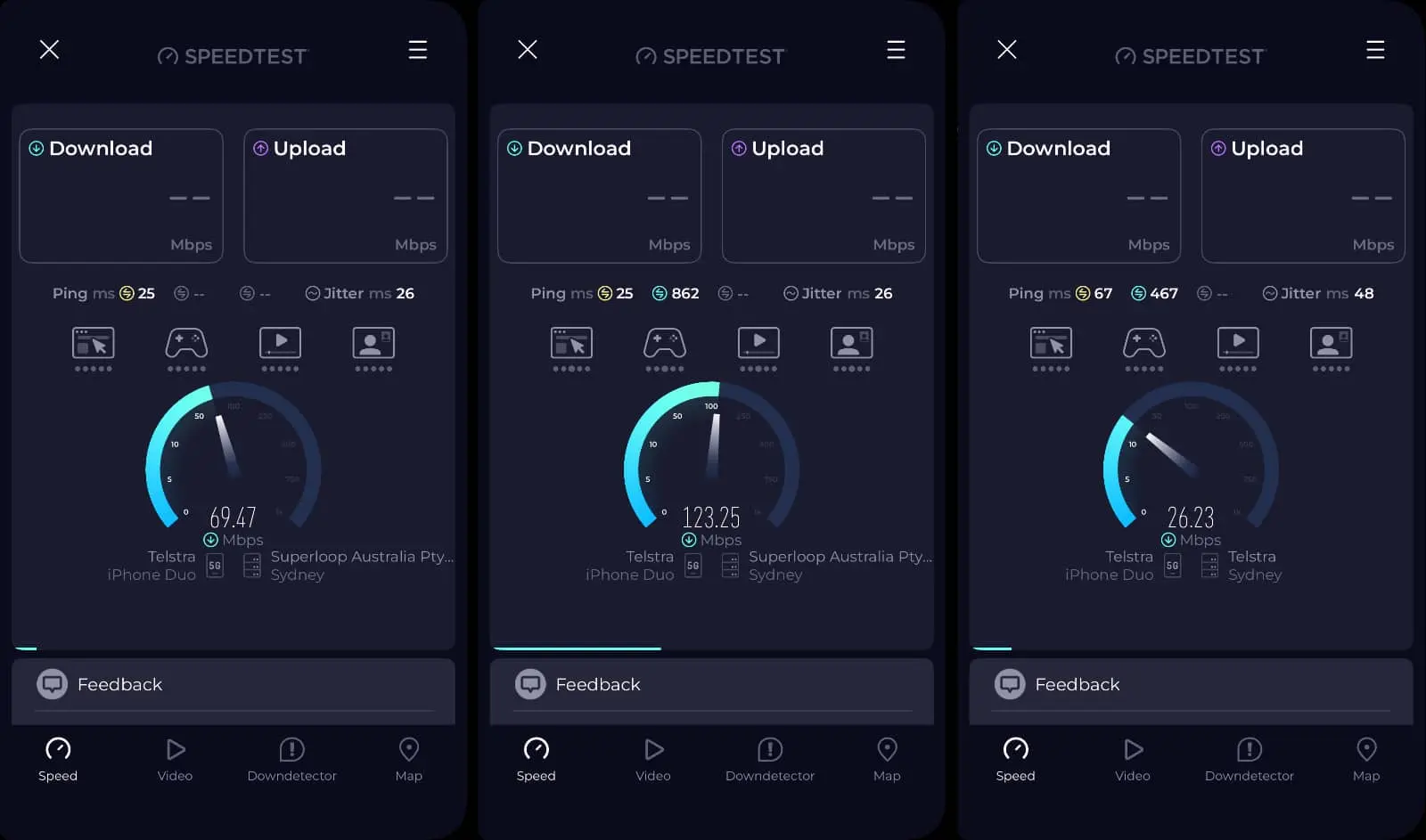
Mobile performance is also good, but these days, that’s not a surprise at all. While your mobile speeds can and will vary based on a number of factors, the 5G capability of the iPhone Duo shouldn’t let you down, regardless of whether you’re checking out the big inside screen or even the smaller one on the front.
Camera
The camera on the other hand doesn’t quite have the same edge. It’s good, but it’s not best-in-class good, and is one of the sacrifices you make for being on a foldable, or even a first-gen foldable.
With fairness to Apple, almost every folding model plays second fiddle to the properly established model in the list. Google’s Pixel 11 Pro XL has a better camera setup than the Pixel 11 Pro Fold, and it’s not alone. The Samsung Galaxy Fold 8 isn’t quite as capable as the Fold 8 Ultra’s camera setup, and the Fold 8 Ultra can’t match the prowess of the S26 Ultra.
Foldable devices just don’t get anywhere near the room to move for cameras, and that’s largely thanks to how much room they have for cameras in general. Keeping things slim is largely what phone makers are going for in foldables, and high-end cameras lose out on that goal.
But you still get something to work with, it’s just not really high-end. Rather, it’s like what comes out of the iPhone 17, offering the 48 megapixel Dual Fusion system used there with 48 megapixels for wide and 48 megapixels for ultra-wide. That’s something, albeit misses out on the telephoto of the pro models and the better sensor technology in the “pro” models.




It’s not entirely the same, because some of 2026’s features are here including Smart Take and Photographic Styles 3, but it’s not a super improvement. Rather, we get the feeling that the iPhone Duo’s camera system will likely be shared with whatever comes with the iPhone 18 when it launches (expected in 2027).
In real-world use, it means shots in daylight are clear, portraits look lovely, and macro images deliver some really lovely detail when you get up close and personal with details that that matter. Low-light by comparison can look a little flat and dull, but the images still work and are relatively friendly for a lack of light to work with.
Selfie cameras are also here, but only one is worth talking about: the 12 megapixel camera on the front-screen supports Centre Stage and offers the good shots, while the under-display camera found on the inside screen is merely a “FaceTime camera”, which seems like short hand for a meagre amount of megapixels and barely good enough to use for anything other than FaceTime chats.
The answer is four megapixels, by the way, with that inside camera being acceptable for FaceTime, but not a whole lot more.
It’s actually kind of surprising that you’re not encouraged to use the 48 megapixel camera with the cover screen in a sort of selfie mode, but you can if you want to. The Duo features both a cover screen preview and the aforementioned clever Snoopy mode for kids, making it possible to snap a photo while seeing a preview or animation to make someone smile.
Battery
We’re not remarkably surprised the camera needs work, thanks in part to just how different every phone camera has been to date.
And yet on the other hand, the battery handles much better than we expected. It doesn’t feel like it should, and the overall size is a dead giveaway that a max of a day is really what you’re likely to see.
But it still delivers more than we expected.
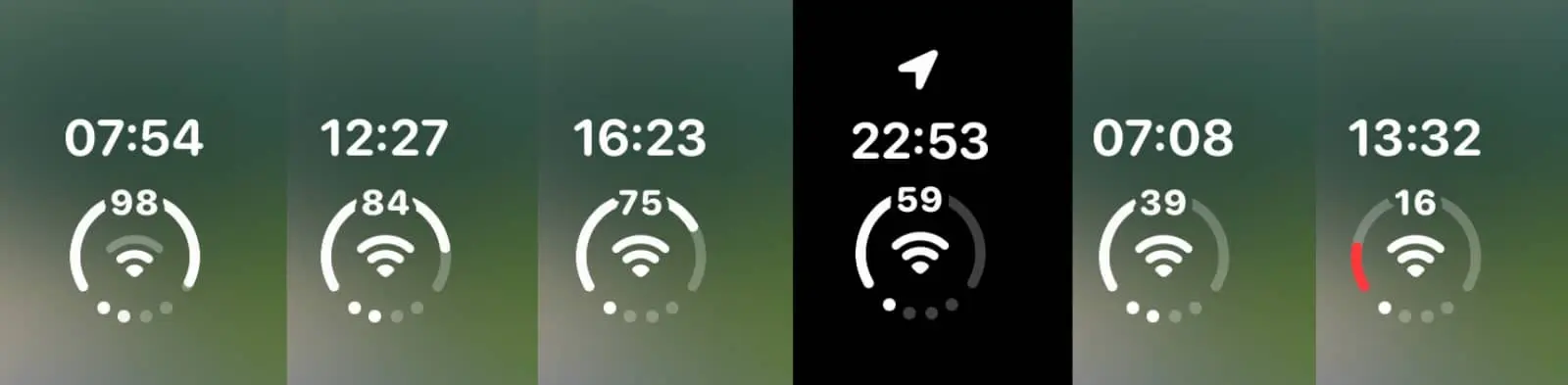
In the real-world testing, we found you would likely want to give the Duo a nightly charge, especially if you’re using both the front cover screen and the bigger display on the inside, or even leaning on the power and camera prowess of the whole thing.
Pull back a little bit, and the Duo battery will behave. We found a day and a half was actually possible in real-world use, resulting in roughly four to five hours of screen use, though, this varied greatly depending on what exactly you were doing.
Testing with Pickr’s bespoke Battery Bench app, you can get even more, getting somewhat near 26 hours of battery life in our tests, topping out at 25:39.
| Device | Battery |
|---|---|
| Apple iPhone Duo |
25:39
|
| Apple iPhone 18 Pro |
24:33
|
| Apple iPhone 17 Pro |
23:54
|
| Apple iPhone 17e |
20:11
|
| Apple iPhone Air |
14:25
|
Granted, that’s just from the cover screen and misses out on the mixed modes on offer here. Chances are you’ll want to charge the phone nightly, but your mileage may vary.
Ultimately we found better battery life than expected, and that goes for when it’s unfolded, too.
In fact, compared to the other folding phone built in this style (of which there is only one: the Samsung Galaxy Fold 8), Apple managed to best the competition’s battery by the smallest of margins. Small still counts, however.
| Device | Battery |
|---|---|
| Apple iPhone Duo (unfolded) |
19:25
|
| Samsung Galaxy Z Fold8 (unfolded) |
18:52
|
All things considered, it’s a commendable effort for battery, and certainly better than this reviewer expected.
Value
The value is easily the most difficult part of the package, because the Duo is just so expensive.
Priced from $3499 in Australia for a 256GB model and able to hit as high as $5899 for the 2TB incarnation, the foldable Duo is hideously expensive. It’s priced so high, it’s more expensive than most of Apple’s laptops. It’s a lot.
As it is, the $3899 model we’ve been walking around with can make you terribly nervous. Four thousand dollars for a phone is not a comfortable sum to think about, and this is the most expensive phone this reviewer has ever reviewed.
In nearly 20 years of doing this, the iPhone Duo is difficult to feel positive about from a value proposition. Yes, the technology is new and high-end, but also, this is a four thousand dollar phone. In this economy. Yikes.
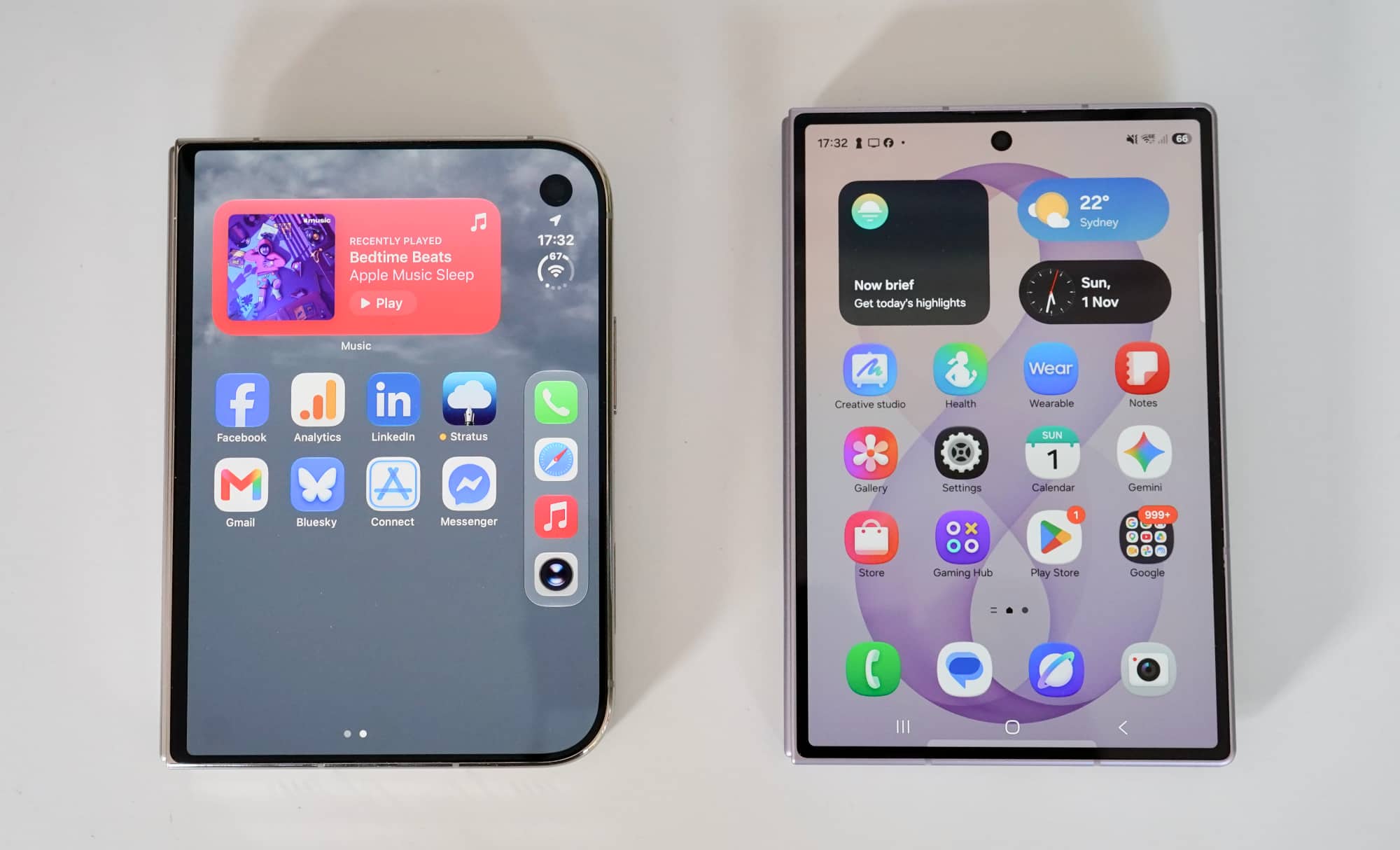
Judging value from that is difficult, though we at least have one competitor we can weigh it against: Samsung’s Galaxy Z Fold 8. Designed with a similar shape and specs, it’s the obvious model to consider, especially because it’s also nearly a thousand dollars *less*.
If anything, that gives us some idea of where the value for the iPhone Duo is. You’re essentially getting Apple’s best foldable, and Apple’s only foldable. You just have to pay up for the privilege.
What needs work?
The price is clearly a problem, but it’s also a first-gen product from Apple, so the price was always going to be a problem. There was no chance this was ever going to be cheap, and it’s an Apple product, so it’s also high-end.
But the price also feels worse than it should. That could be thanks to AI, because in this economy, anything with memory and storage is more expensive than it should be. Thanks, AI.
Beyond the price, parts of the package don’t add up.
The camera isn’t the same level of quality you get on the iPhone 18 Pro models. It’s not just the lack of a telephoto, but also the different camera and its omission of that new variable aperture technology. The camera is good, but it’s more like the 17 camera than the 18 Pro from what this reviewer can tell. It might even be a variation on the 17e’s camera. Not a bad thing, just not a 2026 thing, and certainly not for what you’re paying.
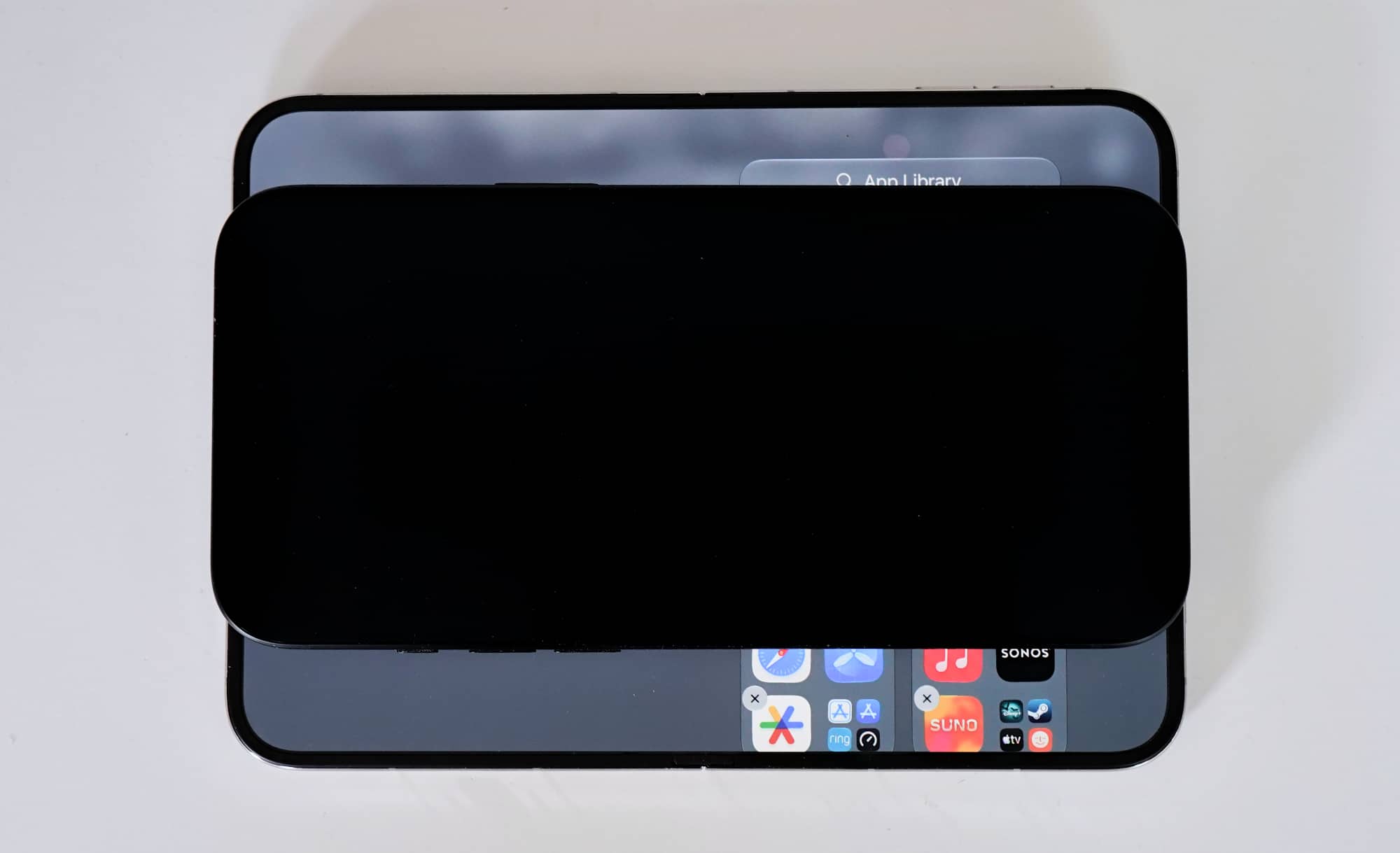
The screen doesn’t give you that much more room for watching videos, either, thanks in part to videos being released in the ultra-wide format more like a 21:9 aspect ratio. That means watching TV shows and films will probably give you the same experience on the big Duo screen as it would an iPhone 18 Pro Max.
We’re not talking about a lot of difference here. If you’re buying the Duo because you’re planning to watch a lot of content, buying an iPad is definitely the better proposition. This isn’t a replacement yet.
App reliability is also a big question mark because at release it is really hit and miss. Some app developers have made the change to adopt the Duo’s new approach, but not all have.
In the time since we started reviewing, the Disney+ app has jumped from being a phone app with big black sides to actually being supported but not designed for the Duo. Meanwhile, neither Bluesky nor ABC iView weren’t supported yet, and neither have a bunch of other apps.
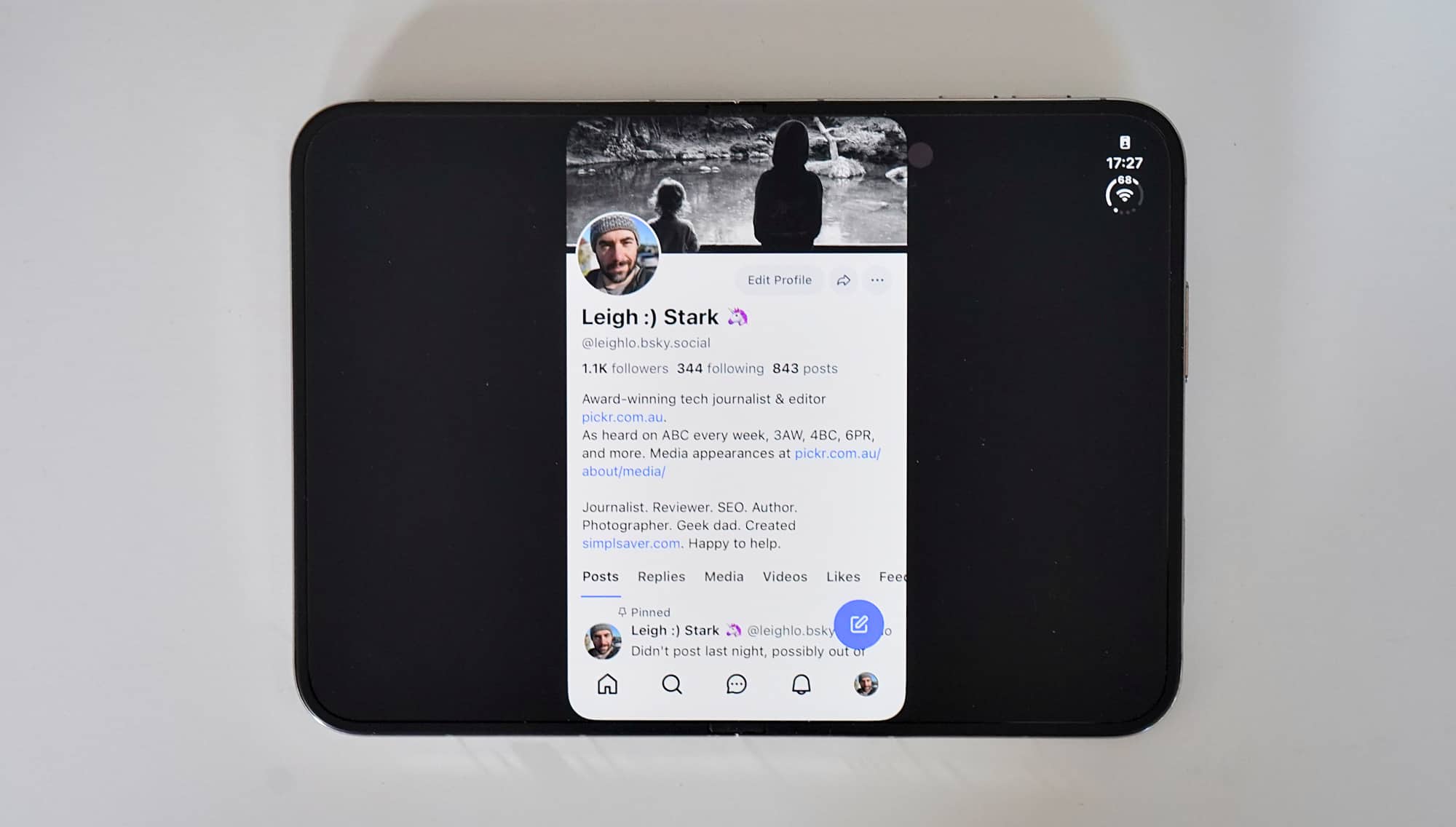
From an app development point of view, this reviewer (and developer) has made the transition on his apps in development, but it will clearly take time for everyone else to jump on board, meaning like the iPad, we could be left with awkwardly spaced apps for some time. Even with the conversions, some apps just don’t make sure of the space well.
Look past the app design issue and you have to then contend with the app reliability issue, which even affects Apple’s own.
Take Safari, which doesn’t always load websites properly in the browser on the cover screen, sometimes throwing content flush with the hinge, and making it impossible to read. Reading through Facebook will work, but you may find the videos all of a sudden load half on the screen and half not.
Running apps on the Duo can be a bit of a mess. Our time is roughly around 70 percent reliability and 30 percent hit and miss. It will clearly improve, but there’s a definite early adoption factor you’ll want to think about in the beginning. It’s clearly there.
And then there’s MagSafe and Qi2, the magnetic charging mechanism Apple has become known for. It’s a feature barely any Android manufacturer supports, and Samsung sure doesn’t beyond adding a case, giving Apple a bit of an edge. In the iPhone Duo, the support is a little less involved.
You get Qi2’s magnetic charging, and when the phone is folded closed, it fits the chargers as well as it should. But the moment you open a Duo into its unfolded style, the magnetic hold is much like it is on the Google Pixel 11 Pro Fold: tilted.
Simply put, magnetic charging isn’t perfect on this phone, and clearly needs to have a stronger hold. It’s a first-generation product, and maybe the chargers need stronger magnets just as the phones might.
You can definitely see the problem, though, and if you lean on MagSafe and Qi2, you won’t be able to lean on it while keeping the Duo open. Not in this incarnation, anyway.
What we love
There are definite issues with the Duo, and while few are real deal-breakers, the price is difficult to come back from. Who would love the price? In this economy — in any economy — how is a starting price of near $4K something you can love? It’s madness.
And yet it’s difficult not to admire some of what makes the iPhone Duo tick.
It’s slick. It’s shiny. It’s well-designed and well thought of. Most devices don’t feel complete from a design point of view, and almost always appear to miss something.
The iPhone Duo is clearly not perfect, but in terms of a foldable made by a company seemingly obsessed with perfection, it feels as close to perfection as possible in 2026. Almost as if to say Apple knows it can’t get the same “pro” camera in, and can’t make MagSafe as strong as it needs to be, but practically everything else that you would want in a device straddling the difference between iPhone and iPad is here.
That could change in the coming years, and very likely will. Improvements to both the foldable variety and Apple’s camera stack could mean a better camera eventually makes its way into a future iPhone Duo. But right now you pay for the fold, not so much the pro-tech which isn’t here. The trade-off is really up to you.
Final thoughts (TLDR)
Apple has long focused on making the best device for everyone, and doesn’t typically concern itself with compromising. It’s a no-nonsense company, and what you get is unapologetically high-end.
That’s not always a bad thing. It means if you’re after one of the best phones every year, you can typically bank on the iPhone being one of them. Anything in the “Pro” line typically matches that without fail.
Anyone can grab an iPhone Pro model and rest assured they have one of the best phones that will keep them going for several years, roughly to the tune of between three and five. Provided they take care of it, possibly longer.
The iPhone Duo feels a little different. It’s still a high-end iPhone, but it’s one where we’re not sure it will stand the test of time, and not just because some owners are already making their way back to stores complaining about cracked screens. That didn’t occur on the iPhone Duo review unit we had, but it doesn’t mean to say it won’t occur on yours.
The durability is one thing, but so too is the feature set. The performance is there, but the sacrifice you make for the camera can be a difficult ask for anyone spending top dollar. And you are definitely spending top dollar.
If anything, it can feel like the iPhone Duo answers a question few were asking: what happens when the iPhone and iPad become one and the same. Both are capable devices — lately almost everything published at Pickr is written on an iPad! — but they serve different purposes.
For folks who need that question answered in one device, the compromise is the camera capability, and you need to be prepared to live with that, and pay for it. And for everyone else, the better approach could well be an iPhone Pro and an iPad. This is one category where right now, separate devices are more useful than converged.
Beyond this, the iPhone Duo is easy to like, but difficult to want to buy. Simply put, it’s a great start for foldable, but it’s not for everyone.
Between the price and the camera, we’d suggest an 18 Pro and a generation of iPad. You might just save money in the process.