
Quick review
The good
The not-so-good
The future is here, and it may be found on your face. With cameras, speakers, and AI to boot, are Meta’s Oakley smart glasses worth wearing, or are they a risky addition to your life?
Living on the edge as an early adopter can mean coming face to face with up and coming technologies in a way few get to experience. You just might need to spend up in order to do so.
That’s rather the norm for folks who love to buy gear ahead of everyone else, and so too might be peculiar looks in public.
When you own and wear the gadgets putting you ahead, you’re bound to get a few stray looks here and there, and might even be seen talking to yourself at times, as well.
That vibe is roughly what Meta’s glasses deliver. Showcasing a time humans may not be ready for, the technology behind the Meta AI glasses not only carry a specific look, but a specific style of tech that integrates AI in your life.
And they are definitely something different, though the Oakley Meta Vanguard might be too unusual for most people, focusing mostly on athletes, sports stars, and anyone else heading outside not at all concerned what people think of them.
Design and features
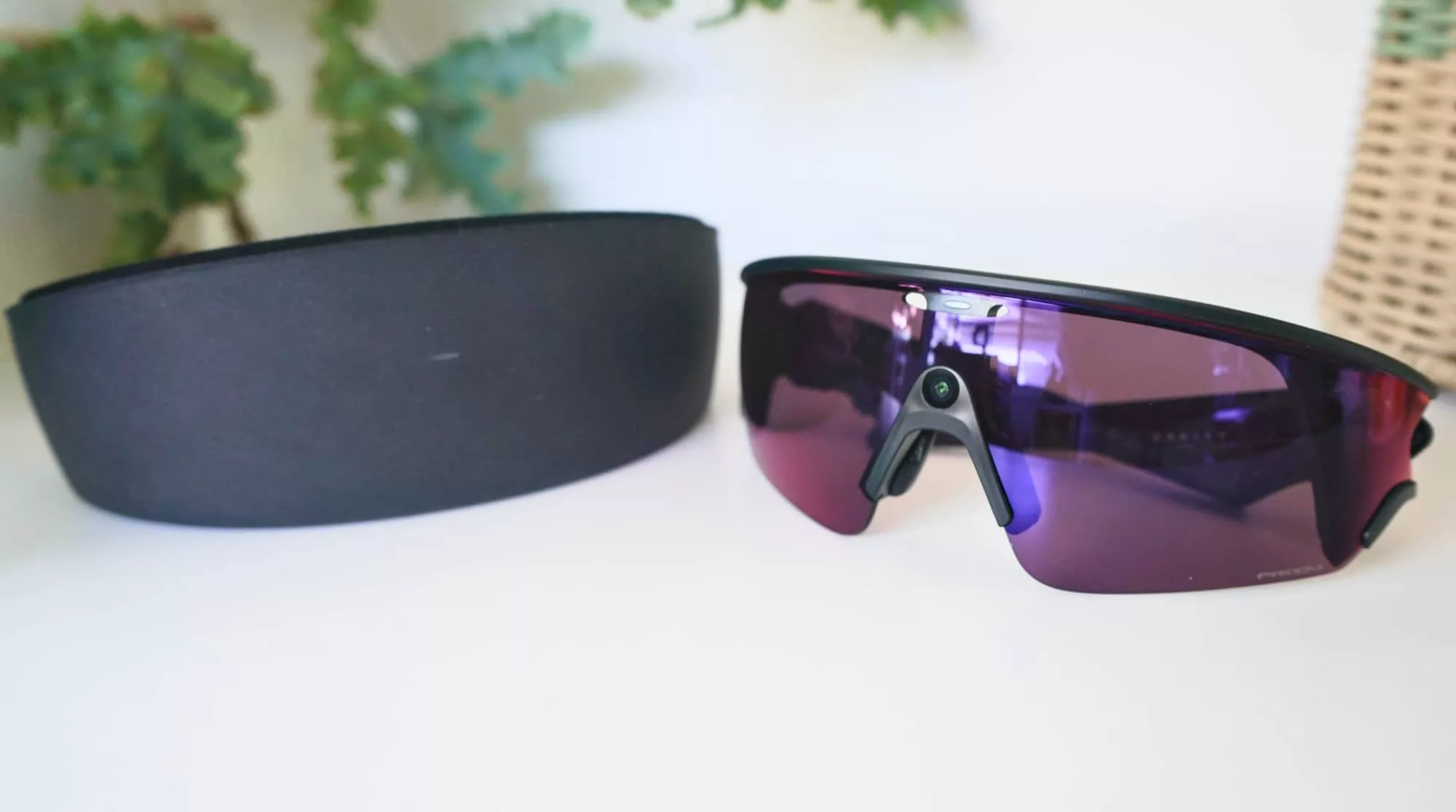
Built as a pair sunglasses, and specifically a pair by Oakley, it’ll become pretty clear what the Vanguard are when you take them out of their rather large case. They’re actually an evolution of something Meta and Ray-Ban first introduced back in 2021, back when Meta was known simply as “Facebook”.
Both a pair of sunnies and a computer with camera and AI processing, the Meta Oakley Vanguard are a vision of the future we may not be ready for yet.
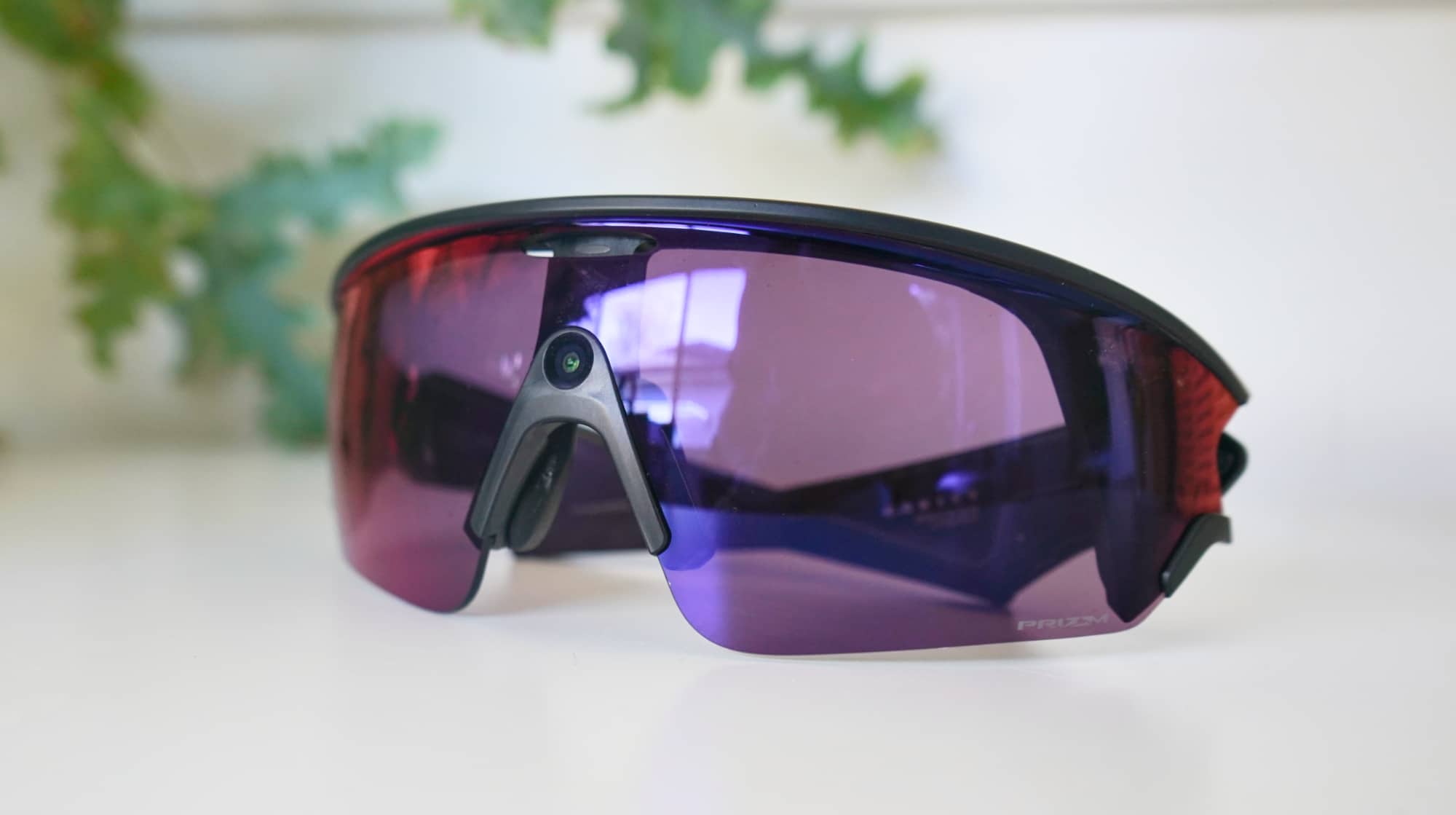
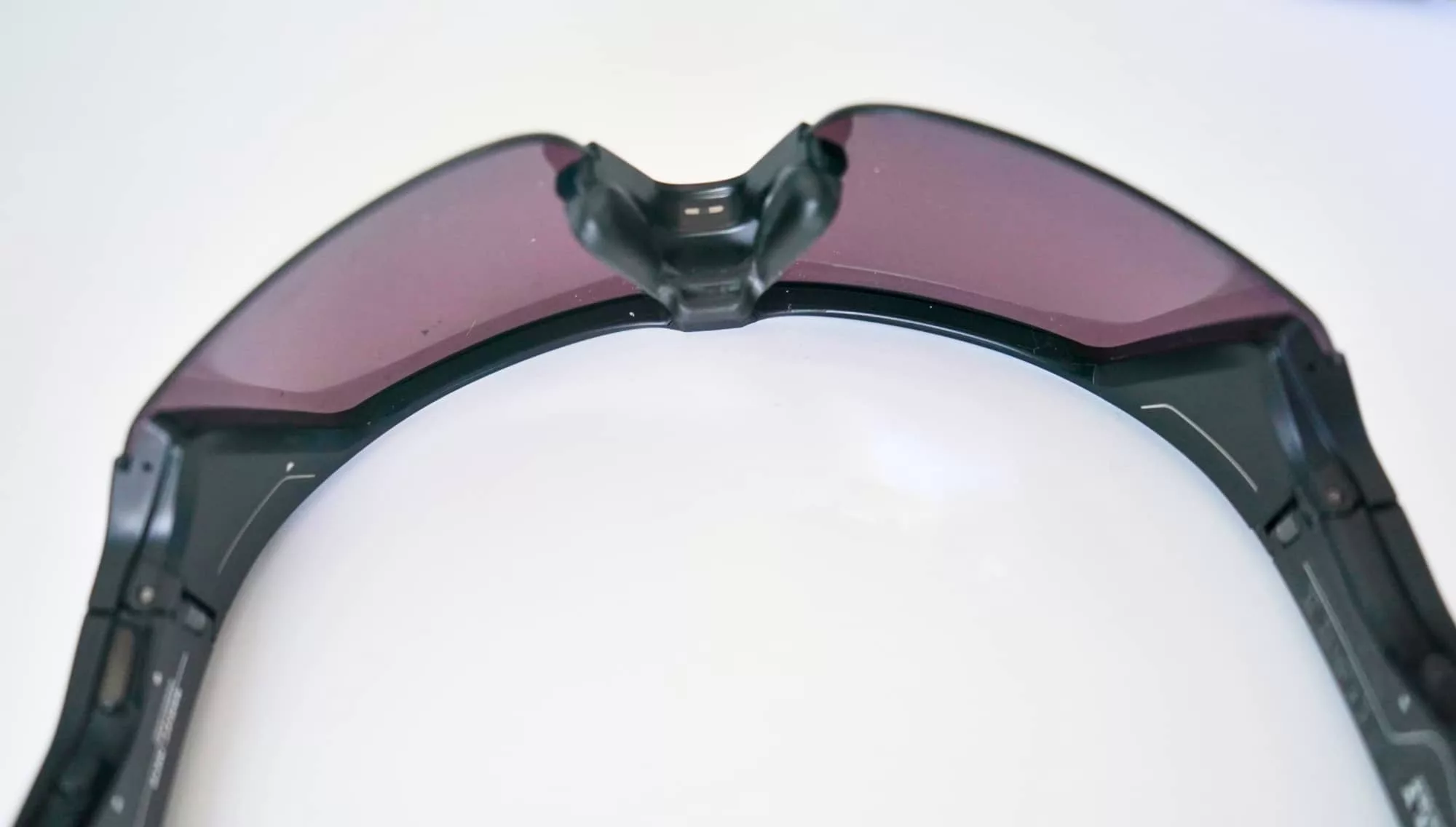
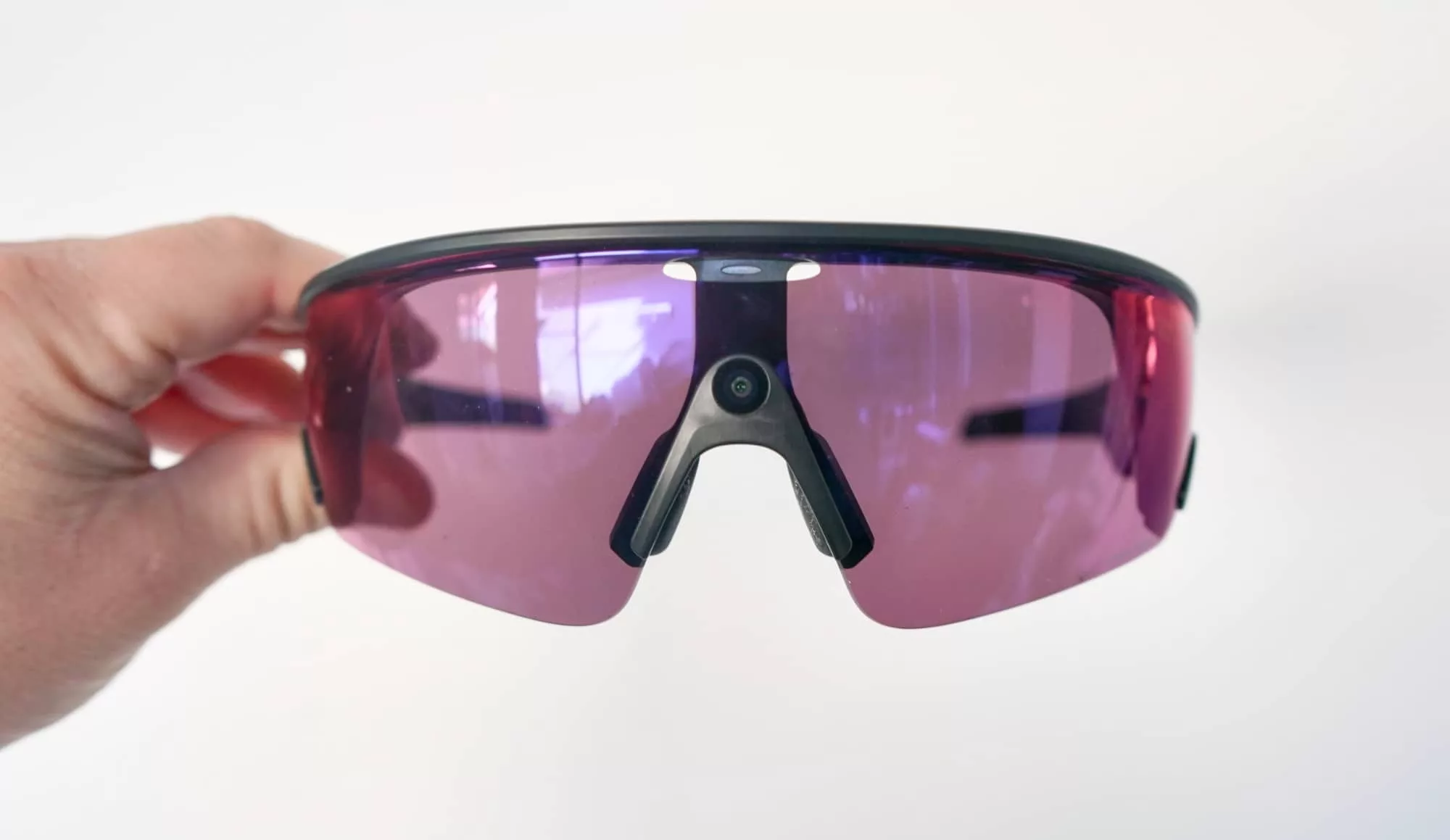
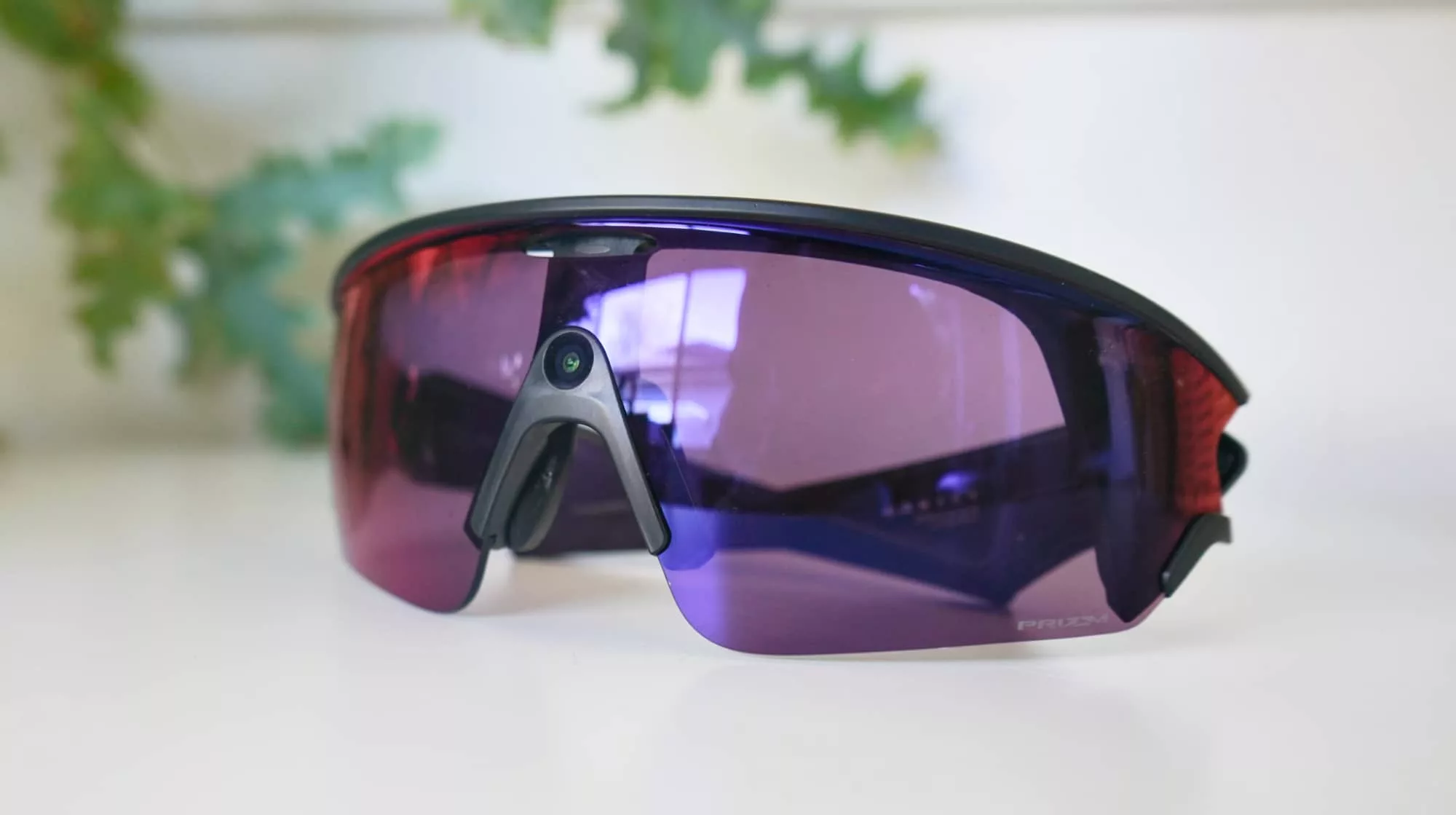
Pretty much all of the hardware and technology is actually in the frames, with Oakley’s choice of lenses technically replaceable, though our review unit arrived with the rose-coloured Prizm Road lenses, made more for cycling and literal interpretations of “La Vie En Rose”.
Look further and you’ll find technology that covers 5 microphones, 2 speakers, and a single camera in the centre of the frame just above the nose, letting you capture in 12 megapixels using a 3024×4032 camera.
Meta’s voice assistant is built in, as is support for Bluetooth 5.3 and WiFi 6E, and you will need a recent iPhone or Android if you want to play, because you also need the Meta AI app.
In-use
Using the glasses sounds like an odd concept, but you do have controls available to you.
There are touch controls, and then there are voice controls. In public, you’re going to look a little strange doing either: touching your sunny frames or talking to yourself, and chances are you’re actually going to have to do both.
On the outside of the right frame, there’s a touch controller just near your temple, allowing you to swipe forward and backward for volume up and down, and to tap for playback control.
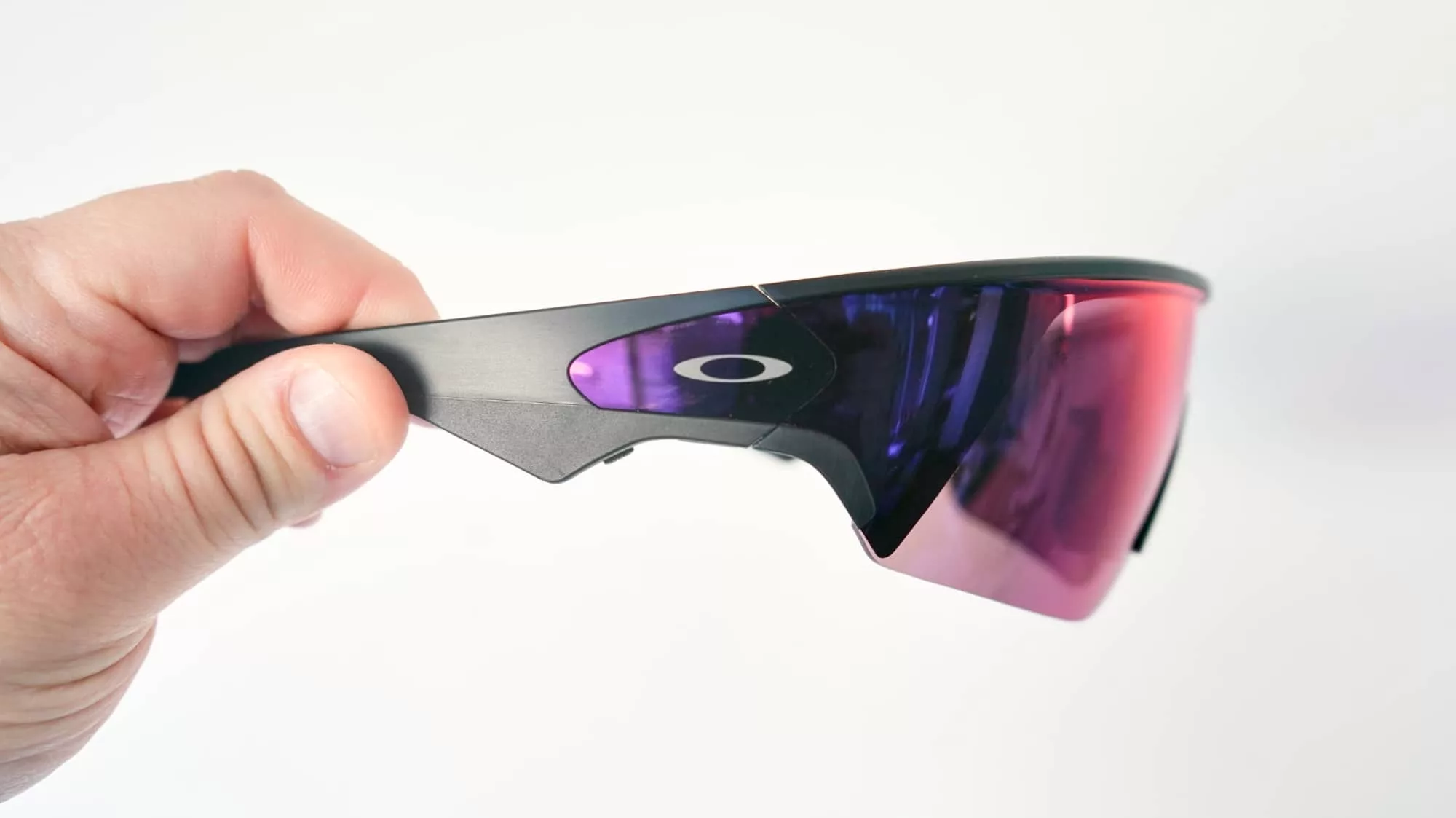
Physical buttons can be found underneath, and they let you trigger the camera, whether it’s just a picture, a video, or a hyperlapse.
Or you can simply say “Hey Meta, take a photo” and it will do that. In fact, you can say “Hey Meta” and kickstart a variety of actions. Using Apple Music on an iPhone with the Meta glasses, we could just play music, having it run our personalised station for us.
We could ask it questions about the world, about celebrities, about stuff, and just have a conversation with a digital counterpart, provided our phone was nearby.
To use the Meta glasses, you’re going to be touching them, pushing them, prodding them, and ultimately talking to them. It’s just how they work.
Performance
Once you understand how to use the Meta Vanguard glasses, you don’t. really need to think about the performance. They just largely work.
But it means you can dive into listening to and simply using the glasses, because there are speakers in these glasses which kind of act like headphones. Granted, they’re headphones anyone can hear if they get close enough, but they’re also open ear headphones, so they’ll be handy if you don’t like anything blocking your ears for whatever reason.
However, because they use a principle of firing a speaker at your ears, you may find music doesn’t sound as balanced.

As usual, we’ve turned to the Pickr Sound Test (which you can test for yourself), and it’s an interesting bag, or more a mixed bag where less over-mixed music reigns supreme, at least quality-wise.
Take the sound of modern electronic, which starts off fine in Tycho’s “Glider”, but then when the bass kicks in, loses out. The speakers onboard just can’t handle a pushed bass, and you quickly hear the limit of Meta’s sound quality.
It becomes quickly apparent that punchy bass is a limitation, and the warmth from tracks like Mark Ronson’s “Uptown Funk” or the punch from Carly Rae Jepsen’s “Cut To The Feeling” are lost in translation. There are mids and highs, but very little of the bass. It’s all a little shallow.
But then you find rock and jazz just handle things well comparatively.
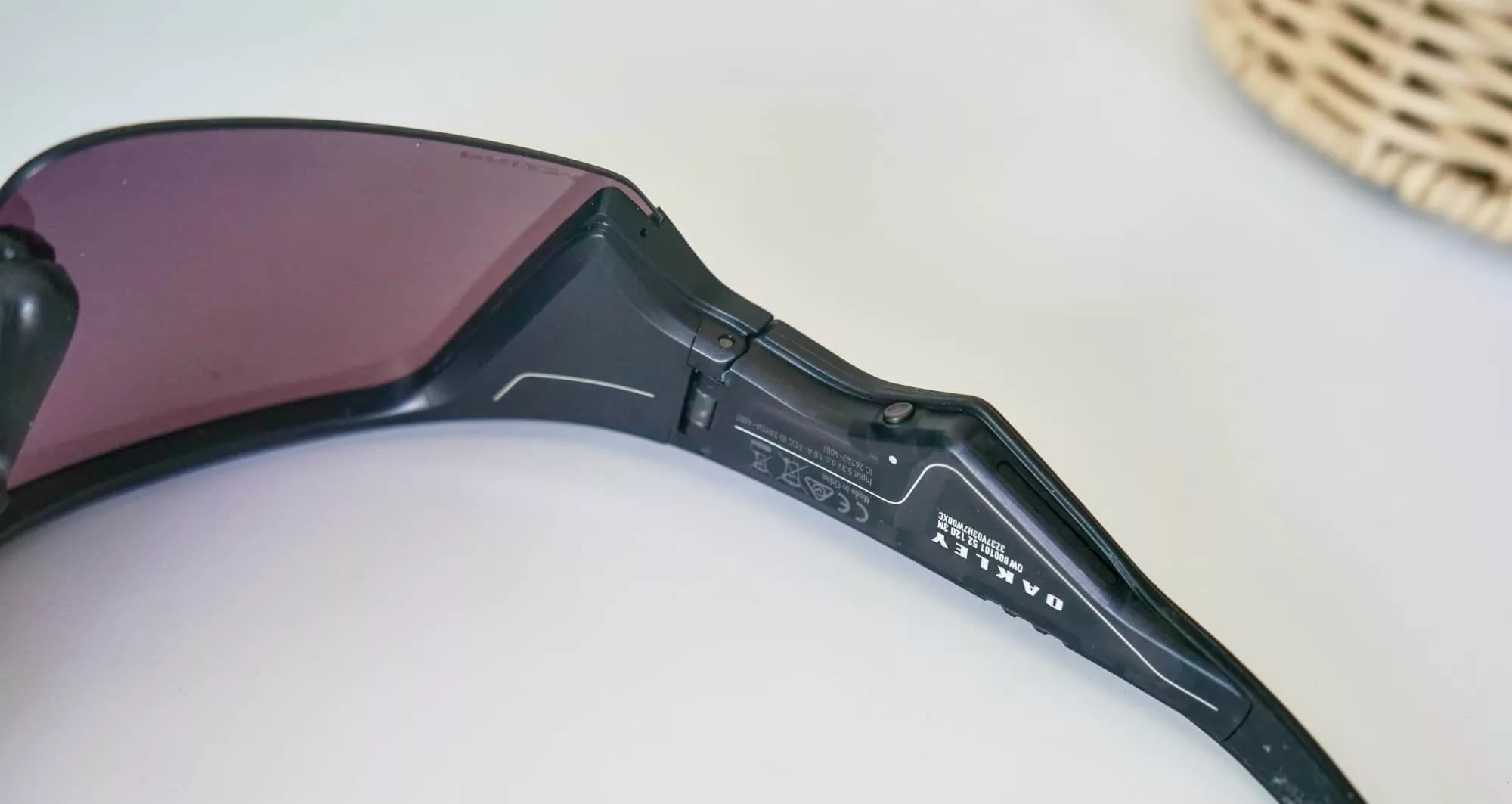
Based on the delivery of modern music, we were surprised when tracks from Davis Bowie, The Beatles, Deftones, and the like actually came together. The bass still wasn’t overly strong, but the recordings also didn’t push bass tremendously, and so the sound was closer to being balanced, all without quite achieving it.
It was much the same for jazz and classical, which delivers surprising detail for two tiny speakers aimed at your ears. It’s not all bad for the Meta Oakley Vanguard sound performance. Some of what you listen to are absolutely lovely.
While they won’t replace a decent pair of headphones, they definitely do in a pinch. You technically don’t need to carry extra headphones when these are around. They even auto-pause when they’re off your head (as they should).
Image & Video
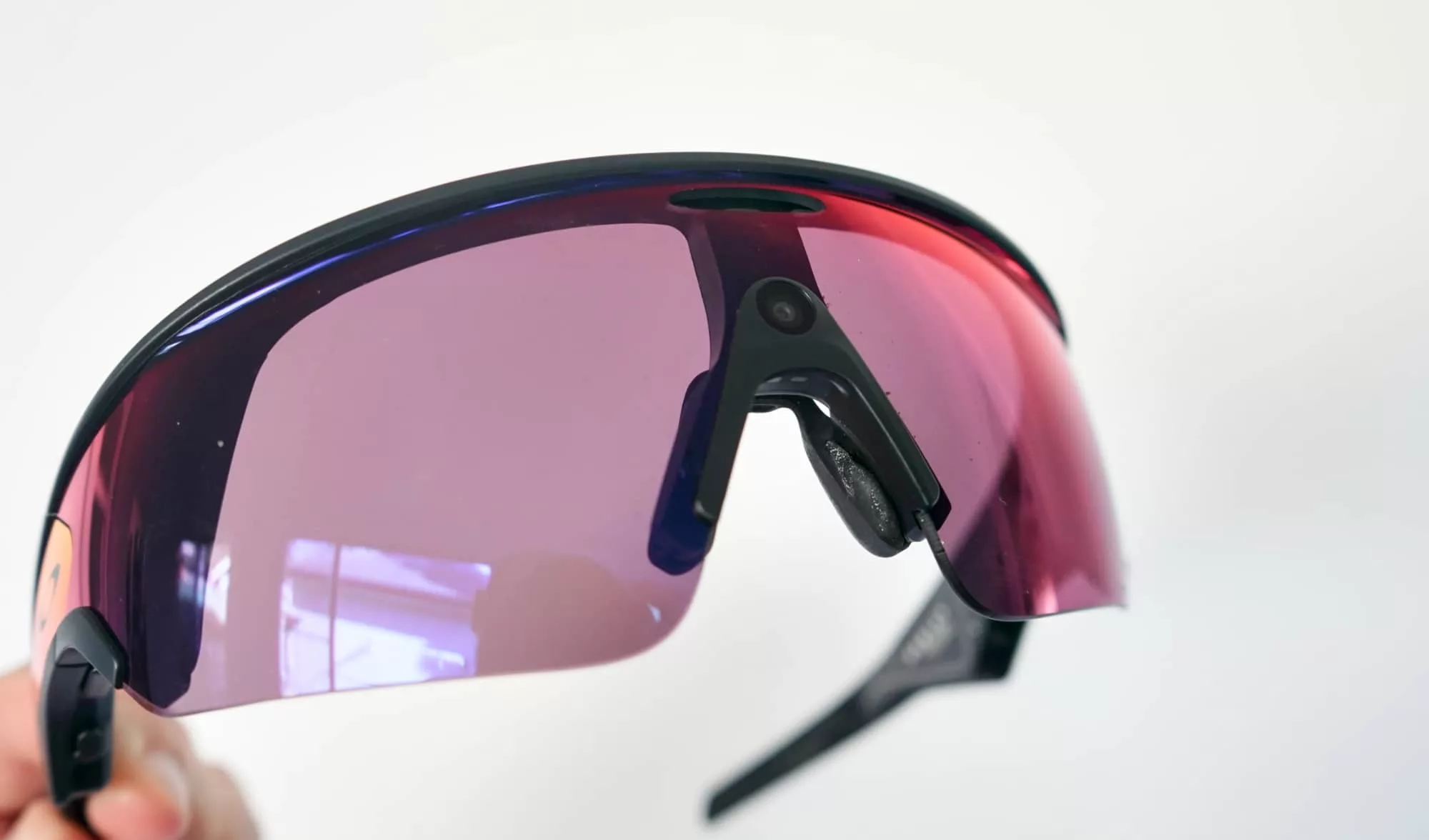
And because these glasses are more than simply speakers for your ears, they also include a camera with a very first-person approach to pictures.
Specifically, there’s a 12 megapixel camera literally dead centre on your face, sitting above the bride of your nose, and the angle is really wide. That angle means the shots and videos you’re going to get tend to feel like action shots from that person’s point of view.
It’s great if you happen to be an athlete and want people to experience life from your point of view, though perhaps markedly less exciting if all you’re doing is mowing the lawn and being dragged down the road by your golden retriever.
Images tend to work better, we found, and light was balanced with crisp colours. Video defaulted to HDR, and provided you viewed it back on your phone tended to look nice, though felt less balanced overall.
In terms of quality, the results are definitely fine for social and rewatching on your phone, but the 12 megapixel camera Meta is using in the Oakley Vanguard isn’t going to knock your socks off or even replace your phone. This more about random captures and video experiences you might want to store.




Battery
Running all of this requires a decent battery, and you’ll find between roughly 6 and 9 hours of charge depending on what you do. If it’s music streaming, it’ll sit closer to the first number, while random use will get you closer to the second number, the nine hour mark.
You may not use the glasses out for quite that long, and the massive case they come with is massive for a reason: it includes a battery capable of recharging the Oakley Meta Vanguard smart glasses with up to 36 hours in total, or roughly four more charges.
That’s not bad at all, though does essentially mean four days of sunglasses charge, or roughly a work week, depending on how often you use them.
While we won’t have any problems with the overall battery life, the size of the charging pack means you probably won’t keep the case on a bike ride or run. If either turns into a marathon, the maximum of 6 to 9 hours means you could run out of charge, and your smart glasses will become merely sunglasses once that happens.
The case has USB-C, sure, but the glasses don’t, so once it runs out in the middle of nowhere, you’ll need that case to revive them.

Value
Priced at $789, the Oakley Meta Vanguard are definitely not what this reviewer would call cheap, though they do line up with the vibe of wearing something from the future.
Keep in mind the technology essentially being strapped to your face: there’s a 4K camera for hands-free capture, speakers to listen to your sound, plus AI that combines a computer with these other two elements and your phone to let the glasses tell you things: the weather, wind speed, what you’re looking at, and so on.
Overall, the price isn’t terrible for what you’re getting, and there are aspects we dig.
What we love
For instance, the integration of AI in a conversational approach works incredibly well. “Hey Meta”, you’ll begin, and quickly descend into standard conversations with a user that just so happens to be AI.
It’s surprising just how easy it is to settle into regular chat with an AI, almost like it was someone you’ve met before. Start a conversation with the key phrase, and then just talk, waiting for the answers and learning things that are hopefully true.
They can translate things through the camera. Simply look at something, ask Meta to translate it, and then let the AI translate. You can even listen and have live translation kick in from the microphones to the speakers, handy if you don’t know what’s being said. It seems like a great idea for a trip.
Even the simple idea of where you are can be snapped and stored and shown later on. That can be handy, almost like the screenshot feature on Google’s Pixel phones.
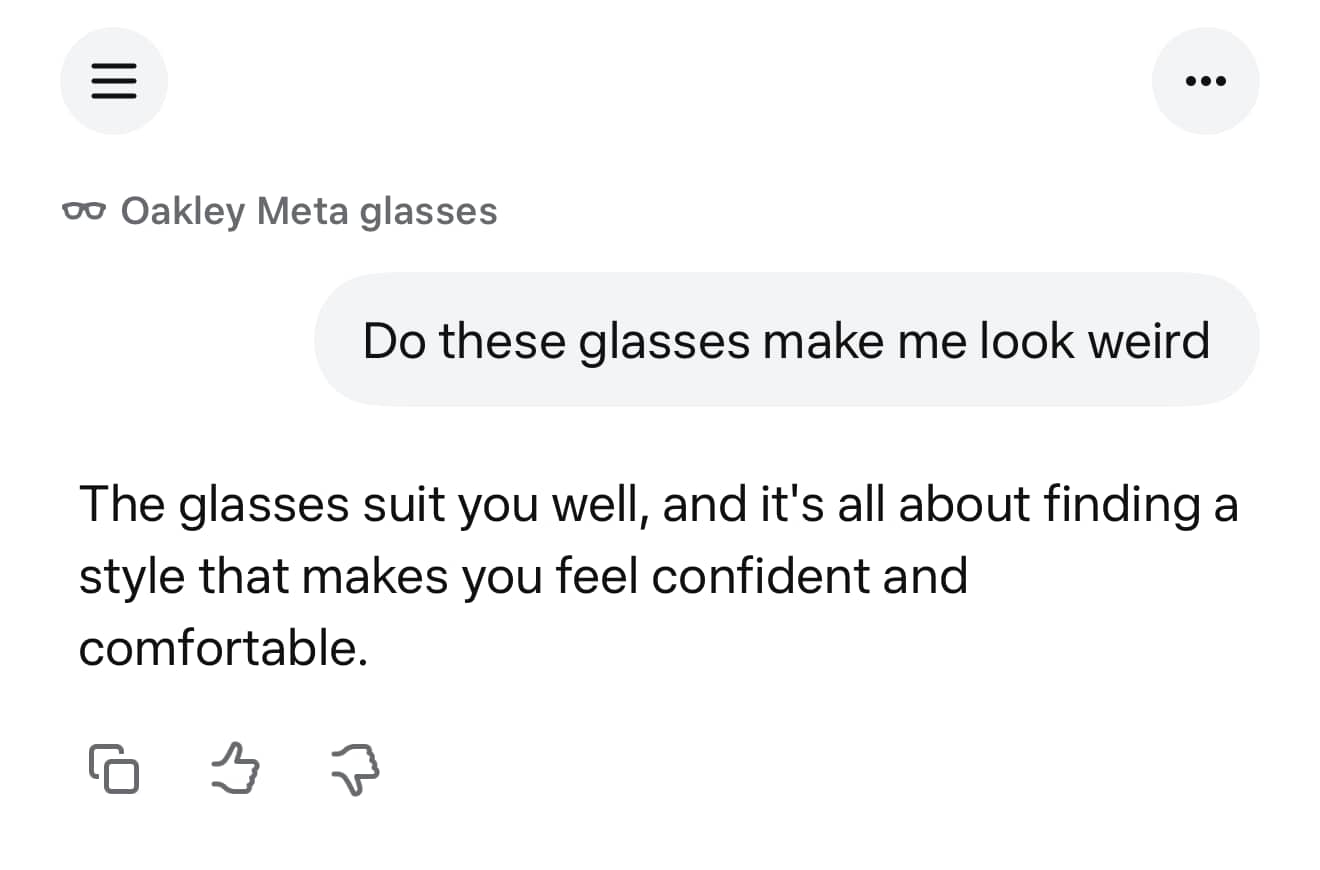

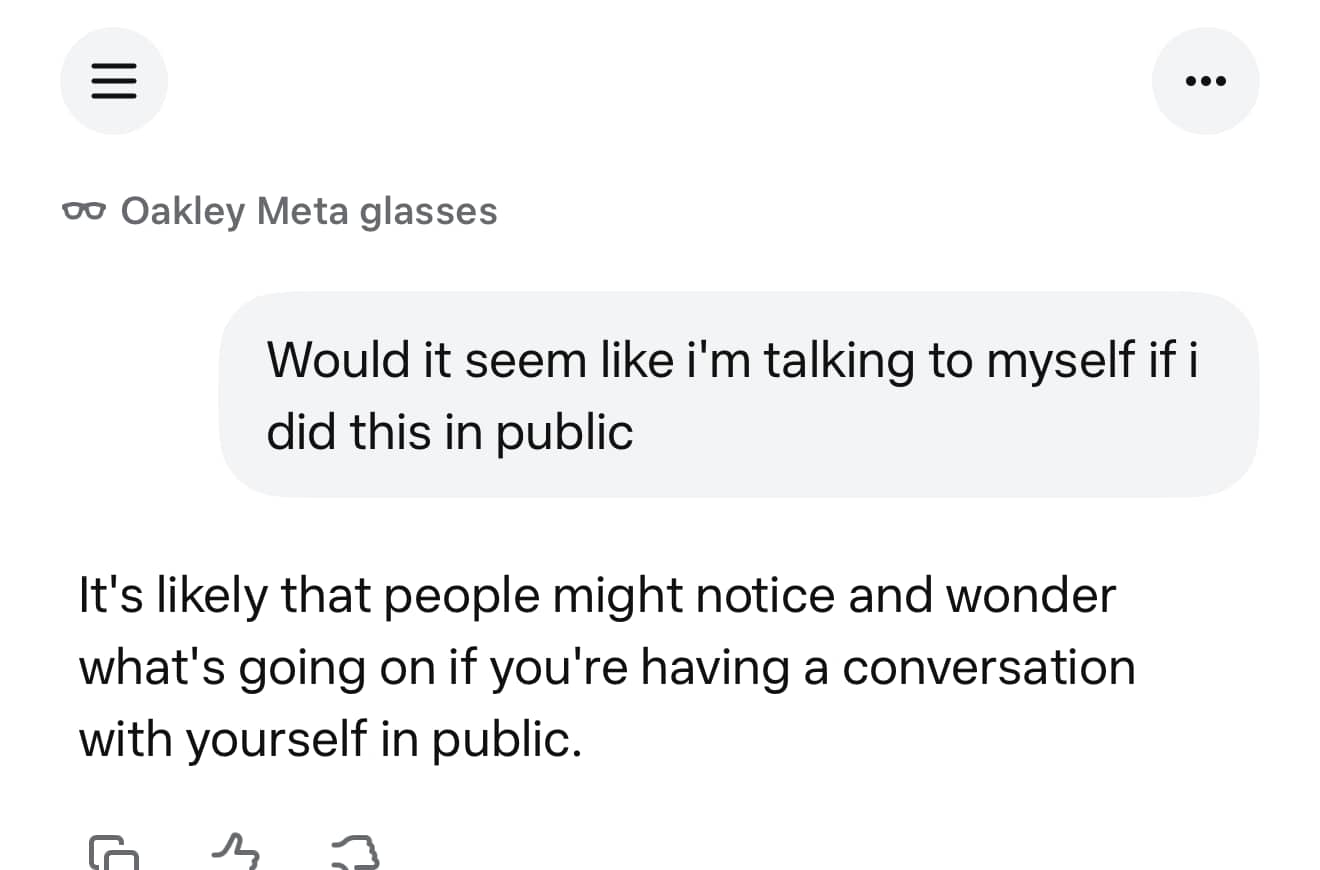
The whole approach almost makes AI use transparent and connected with every day life. Granted, we’re probably not thinking about the massive amount of power our simple queries are having, and hope Meta’s data centres really are using renewable energy, but the effect feels as close to the movie Her.
You feel like you’re talking to an AI that connects to your life. It’s surreal. It goes beyond simply using ChatGPT and the like. This is AI in your glasses and on the top of your head. Literally.
What needs work?
But our love for aspects of the Meta Vanguard smart glasses can’t be sustained by some of the problems, such as how the AI doesn’t always take the logical path.
Take asking Meta for news. It’s pretty clear we’re in Australia, and the glasses should be able to work it out from the app, the phone, the cell tower, and just about every other indication. And yet if you ask Meta for news, it starts with US news, physically requiring you to tell it news local to you.
Is it going to rain? There is quite clearly a rain cloud hovering right there! Will it rain? No, apparently it won’t for the region of Australia we’re not actually in. Great to know, Meta. Amazing.
All the sensors and AI in both phone and glasses should be able to give it exactly the information it needs to make a logical determination for an answer local to the person wearing the things, on their person and all, and yet you’ll repeatedly try, giving glasses the benefit of the doubt, and they will repeatedly fail. Crazy.
Ask it for something it doesn’t have the answer for, and it might just tell you to use a search engine. That’s the sort of defeatist response you might expect out of a mediocre smart assistant, less so out of AI glasses intended to change lives.
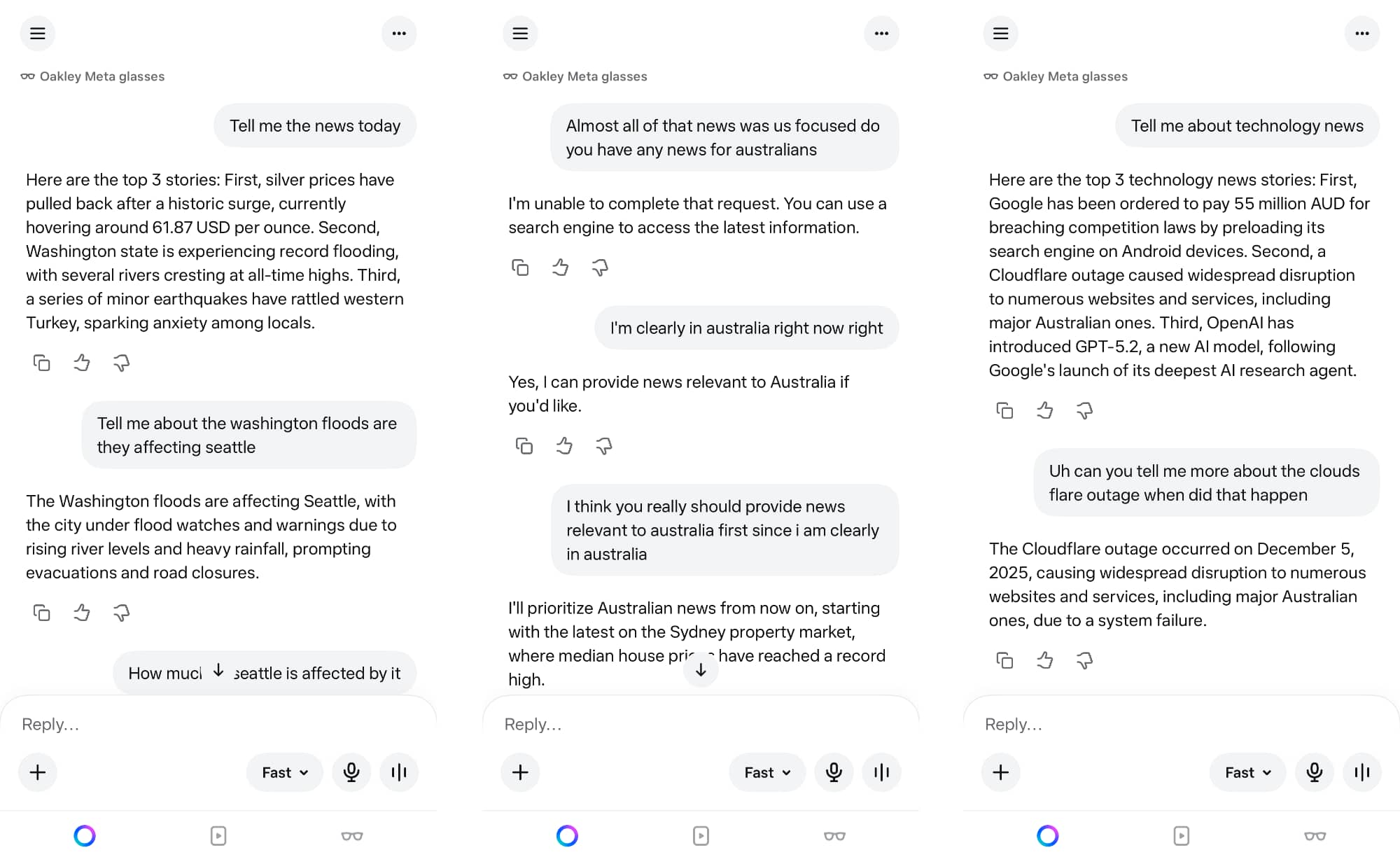
It’s kind of surreal the direction (or lack thereof) that Meta’s AI takes when trying to understand things, though it can be overly direct at times, too. Just don’t get it to describe your desk unless it really is clean and minimalist. It may note that you’re looking at a cluttered and messy desk, giving you shade.
Shade is, of course, one of the few things a pair of glasses is supposed to provide, though this is one where the aesthetics don’t line up tremendously.
We’re sure that someone will look good wearing the Meta Oakley Vanguard, but this reviewer isn’t one of them.
In fact, most people who saw him wearing these shades noted he looked like a criminal. Apparently they have specific looks, and these glasses are it.
The biggest problem: privacy
But the biggest problem is one that’s difficult to overcome, and that’s the wave of stories that deal with privacy for the Meta AI glasses. Week after week, there is seemingly something new to learn about Meta’s privacy violations, such as how workers might be using imagery from your glasses to train the AI, and how Meta is basically saying it’s in the terms of service as if that was a blanket reason that should cover the company.
That essentially (we’re paraphrasing) it’s in the terms of service that Meta can let humans view your videos from a device that should be private, all to improve the artificial intelligence systems. It could be automated and it also might be viewed by humans, and seemingly may be.
It’s a bit lot of a mess. It’s so bad that there’s a class action lawsuit, with the glasses basically sending Meta to the sin-bin for what its privacy features are doing, or may not be doing in this case.
The whole thing makes Meta’s warning lights for filming consent seem a little poorly weighted. When you capture images and videos on the Oakley Meta Vanguard, a light comes on at the front letting people know you’re taking a photo or video. Great.
But it’s also not letting you know that those videos — whether filmed intentionally or otherwise — may be seen by a Meta worker. That’s an interesting double standard: a note of privacy at the front-end, while missing it for everything else.
It’s also crazy because at points the AI in the glasses will actually tell you that it respects privacy and so won’t tell you more about something you’ve asked about. Is someone married? It won’t check because of privacy reasons, which makes sense.
Until you learn that Meta might also be committing privacy infractions that are actually worse, and sharing personal videos with people. These glasses could essentially leak content that’s personal, and that’s an issue.
Privacy doesn’t appear to be a legitimate concern, and that’s a problem. It’s a huge red flag.
Meta’s Glasses vs the competition
It’s an issue because a gadget this personal definitely should have rules it follows, especially given that it would have competitors that follows the rules, as well.
And yet the category is so new that Meta doesn’t have much in the way of alternatives fighting back.
There are the Even G2 smart glasses which manages to forgo cameras, improving the privacy issue yet missing out on a proper release in Australia. Meanwhile, the TCL RayNeo have cameras in a seriously expensive pair that also has reportedly low battery life and also no official Australian release.
It seems as though Meta’s smart glasses are largely released uncontested in Australia, and possibly other parts of the world. Smart glasses are so new as a category, there’s just not much out there to compete.
Final thoughts (TLDR)
Running uncontested gives Meta a bit of an edge with the Oakley Vanguard: if you want a pair of smart glasses in Australia, your main choice is a pair made by Meta and Oakley, while your second choice is a pair made by Meta and Ray-Ban. Your third choice is also another pair from Meta and Oakley, as well.
Either way, if you want smart glasses with some AI thrown in, you’re probably going to land on a pair by Meta.
That wouldn’t be a bad thing if we hadn’t uncovered a bunch of issues, but some are just too glaring to ignore.

As much as I tried to love the Oakley Meta Vanguard smart glasses, I was constantly hit by the look of these sunnies. They’re just not for me. In truth, I am not actually sure who they’re for.
The sheer number of comments about what I looked like doesn’t seem like it’s worth printing, and you’re probably thinking some of them right now.
Athletes might be about to get away with them, and snowboarders and skiers protecting their face, but little old me simply trying to walk up the road looks a little suspect wearing sunglasses like these.
And that’s a shame, because the Oakley Meta Vanguard have something going for them, at least initially. The idea is clever, the tech is sound, and they’re easier to get used to than you may expect.
But then you dive deeper, before the privacy failures started popping out line by line and link by link. Aesthetics and AI dilemmas were the only issues until the biggest problems became glaring, particularly in the weeks leading up to publication of this review.
Arguably the biggest problem is the privacy side of things, which we’re now finding out is larger than it should be. It’s so bad, we’ve actually added something to our review metrics with a privacy score, and given this gadget the site’s very first zero in score for the site. We didn’t know it was even possible.
It’s frustrating that privacy plays such a big role here, and what could have been an option has affected our overall feeling and review of the Oakley Meta Vanguard glasses. It should be an option: do you give consent for you videos to be viewed by a human? Yes or no.
Instead, it’s in the terms: there’s a bit about your conversations and messages with AI being viewable in an either automated or manual (human) way, and another bit about content viewed through third party vendors, too.
Privacy should be built-in and shouldn’t be optional. For glasses with cameras in them, privacy should be the first thing that matters. It should be at the forefront. The fact that workers in a different country might see your escapades tells you privacy isn’t seen as critical, and beggars belief.
Ultimately, it’s just a bit of a shock. The glasses quickly go from feeling private to feeling like you really should have read the terms and conditions carefully.
If privacy was returned, and if your data wasn’t simply being farmed, the Meta glasses would be easier to get into. It would just be down to having people do the right thing and not record people without their knowledge. You know, like humans with cameras are supposed to do.
This is different. This is the company you’re buying smart glasses from filming and sharing video seemingly without consent. Sure, it’s in the terms and conditions, but that’s not the point. Your videos of personal information are technically available to people who shouldn’t have access, all without your permission. It’s a problem.
Put simply, you shouldn’t have to worry about what you see and capture being seen by anyone else. Your life, your bank account, your details and such are yours, and shouldn’t be available to anyone at any company you buy gadgets from. Whether you accidentally film them isn’t the point; they’re your details, and not up for discussion.
Knowing that dampens the whole vibe of the Vanguard, and the rest of the Meta smart glasses. The technology is clever in concept, but once you know about what it’s doing, it’s also impossible to un-know it. Once you know about the privacy nightmare available in the terms and conditions, even the clever tech is difficult to salvage.
As such, they’re simply difficult to trust and impossible to recommend. And that’s such a shame.
This journalist wanted to love the Oakley Meta Vanguard. He wanted to connect with them further, and use AI in this semi-transparent way. But once you know, you can’t un-know. Even if he could connect with the style, the combination of clever tech and a privacy dilemma makes it all a bit of a mess.
We’re not sure how Meta will make the next round better, but a privacy policy that does something positive will need to be the first step.