

When two of Australia’s musicians found they were part of an AI training system for AI music services, you wouldn’t have found many people who were legitimately surprised.
The flagging of music from Powderfinger’s Bernard Fanning and Something For Kate’s Paul Dempsey (who together tour as “Fanning Dempsey National Park”) being used in AI training set libraries isn’t necessarily indicative of music being used for services, but definitely hints towards a likelihood.
Ultimately, it added weight to allegations that music from known artists had been used without their permission, training AI music systems to allow people to take advantage of the talent and skill from each artist, and create their own equivalents.
Talent on-tap and music made easy. Much like how AI can seemingly create text and imagery out of nothing more than the patterns it learns from existing content, so too can it make music in much the same way. Clearly music isn’t the same as what it used to be.
Whether it’s an actual form of creation is debatable, because it’s reusing everything it has sampled before to build something else. All it needs is everything creatives have made before it, some computing power in the cloud, and then a prompt.

A stew and soup of sound
The “everything” that came before it is, of course, owned and created by someone else. It’s then used to build new things, though makes for a problematic situation for the people who made the original music and makes a living from it.
Their rights are essentially being eroded, all for the sake of a digital progress no one really asked for.
There are things AI can do that are genuinely beneficial, such as analysing data quickly or understanding patterns to improve medicine and science. Even generative AI can be useful, lending a helping hand for transcription and translation, to name a few uses.
Cheating the creative process by using someone else’s music to make your own isn’t necessarily one of them, and it understandably has the music industry worried. For good reason, too.
While the big players have acknowledged to using copyrighted material in their training data, it’s still a bit of a question mark mixture of rumours and guessing and suspicion.
That was until The Atlantic opened it up and compiled a sortable list of training data seemingly used by some of the services. There’s no specific guarantee or checkmark as to which service used what, because AI doesn’t typically just reference a catalogue of tracks.
Rather, AI blends everything together, turning audio into a series of labels and sounds and rhythmic descriptions and notational concepts derived from the musical tracks it has learned from. The system brings that all together almost like it was a divining rod being stirred into a stew and soup of sound, swirling the building blocks of musical mastery to get a result by mere prompt alone.
When you ask it to make something and work from a prompt, an AI service takes the message, breaks it down into core components, and looks for the joins and labels and descriptions, pulling it all into a blob until it becomes an engineered track and record.
Gone is the expertise and experience needed to compose a track, when all you need is a prompt defining what the track should sound like, and a field for the lyrics.
You don’t even technically need to fill that section in; AI can also take the job of writing words to your song away from you. They’ll probably be tacky and meh, but you also may not care. They may even be as good as some Top 40 hits today or similar.
The end-result will be a song you contributed no real creative effort to, but could still sound totally fine and listenable and ready for radio all the same.
With over 75,000 AI tracks uploaded daily to music services, your song could just join the throng, albeit with marginally less original poetic license than that last line. And the artist you drew inspiration from will get nothing, nor will the music label. Their contribution has been made with or without their permission.
“This is just a question of fairness. These big tech companies want to use our artists’ music to train their models and make money, then they need to ask and they need to pay reasonably negotiated licenses,” said Chris Maund, Co-CEO at Mushroom Group, following a press conference to work with the government in securing rights for creatives across the country.
The unspoken rule
There is an unspoken rule of AI music, beyond the obvious one of “don’t use it”.
You don’t need to pick up a guitar or a keyboard, or even do anything remotely creative at all. You simply can’t invoke the name of an established artist.
You can’t say “make me a song by” and then name a famous artist, as in “make me a song sung by David Bowie”, or words to that effect. You can’t tell it to make a song by Elton John. It’s not allowed, and music services will block those attempts, shifting you to descriptive words that are similar, albeit not exactly the same.
Clearly, there’s a great reason why: artists and labels own their music, sound, and vocal likeness as a form of intellectual property rights. When a recording deal is signed, labels have effectively paid for the artist to bring these qualities and their catalogue with them.
If anyone could simply come along and make their own music in their name, it could create major problems.
AI has already shown this sort of thing is possible, albeit in different ways. You only need to look at how unauthorised bootleg AI songs from artists exist on the web, some of which resurrect past artists and let them speak once more in a morbid array of AI voodoo deepfake video witchcraft.

Actual music labels tend to have access to the rights to create AI tracks, something we’ve seen from The Beatles prior, and they aren’t the only ones. They can create new tracks legally using what’s available to them, and with permission.
But if you don’t have access to those tracks and you want to recreate a style, a sound, or the overall vibe of an artist, AI can still work aspects of the equation out.
When you ask an AI a question, it breaks up the query into pieces and attempts to understand it logically, semantically, and with an overall intention. Different types of queries result in different breakdowns, with some being given descriptions depending on what they are.
With music, the query is broken into lots of parts: the name of the artist, descriptions of the artist, descriptions of their sound, descriptions of the band’s sound, of the band’s songs, and so on and so on. It’s almost as if the elements of music could be described and mapped to a genome, as DNA becomes a music-focused strand we can all understand.
While that can be quite complex, it’s normal for people to simply start with the name of an artist they’re attempting to recreate.
It’s an approach AI music platforms are effectively trained against, or they’re supposed to be, anyway. Artists are supposed to be red flags and left untouched, likely for fear of drawing the ire of the music labels.
Our testing shows that clearly doesn’t work.
You’re not supposed to say “David Bowie”, and for the most part you actually can’t. But there are plenty of Australian artists in the libraries you can say the name of, and the AI music services barely bat an eyelid.
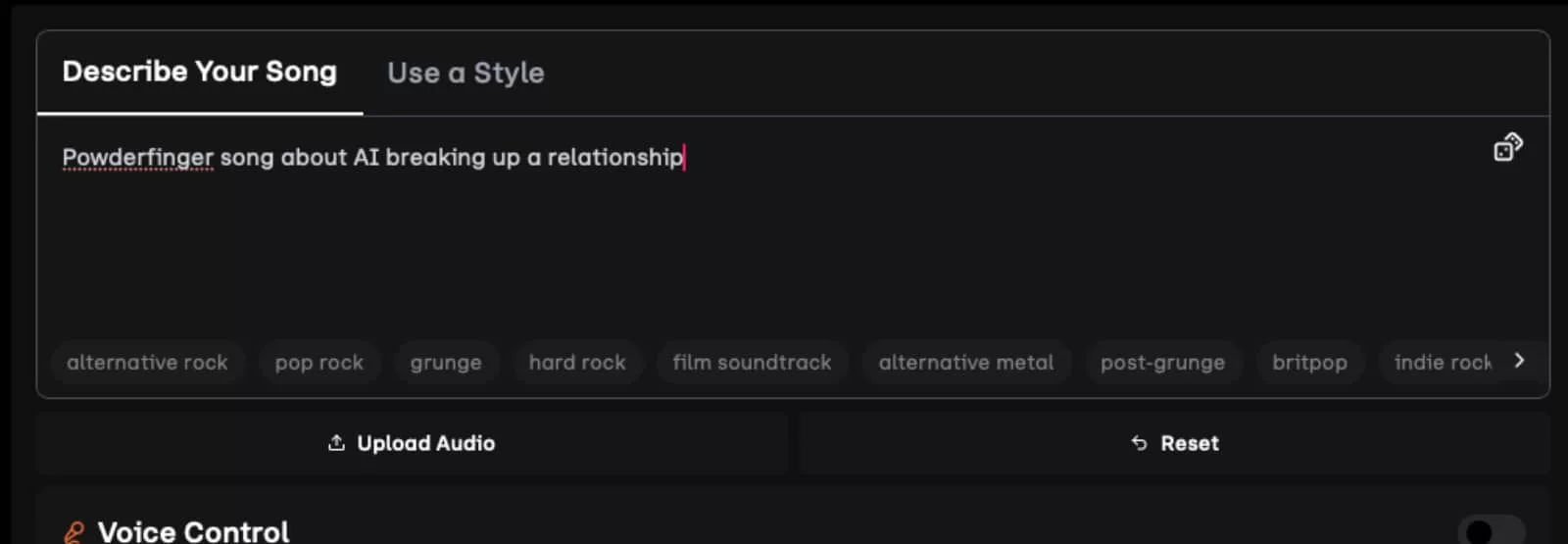
Over on Udio, Paul Kelly, Vance Joy, and Kylie Minogue all flagged as artists, but John Farnham didn’t, and he wasn’t alone. Neither did Powderfinger, Bernard Fanning, Something For Kate, Paul Dempsey, Hilltop Hoods, Pete Murray, Regurgitator, Ben Lee, The Superjesus, Missy Higgins, and Eskimo Joe.
We could have probably spent more time and credits working out which artists weren’t triggering the artist warning, but sufficed to say, there are a lot.
Suno was a little tighter, recognising Hilltop Hoods alongside Vance Joy, but not Missy Higgins, Eskimo Joe, Bernard Fanning, Powderfinger, or even John Farnham.
Out of these, simply mentioning the name of an artist rarely achieved a result like the artist. Almost none nailed it.
A cloned Eskimo Joe wasn’t far off, while a cloned Missy Higgins didn’t quite match the voice of one of Australia’s leading pop rock musicians and who recently gave some thoughts about the AI music conundrum. Meanwhile, AI managed a half-convincing 80s style of John Farnham, but it lacked the heart and soul of Australia’s “voice”.
A clearly fake clone of John Farnham
When Suno recognised Vance Joy, it threw out the official use of the artist’s name, yet delivered a replacement which also achieved a close sound, albeit one which clearly lacked dentists in the dark or riptides (which is a good thing, because the lyrics lacked them, as well).
The AI-music making cheat code
While the unspoken rule of AI is to not mention the name of the artist you’re trying to clone, there is also a cheat code for the services to get close to the artist sound. Perhaps unsurprisingly, it’s to use more AI to get it all connected better.
Specifically, the cheat code in getting the AI to mimic a sound is to understand how AI interprets information, and to use that same approach to let you define the sound you’re after.
What you’re after isn’t the name of the artist, but rather a description of how the artist sounds, because that’s how the information is also stored in the system.
It’s how it would have been trained in the first place.

When AI music service companies train their models, their systems apply those attributes like little flags to each band and artist and song and track. They whittle down what’s given and join the dots, sorting sounds into descriptive labels, which can then be used to understand music almost taxonomically.
And because AI systems are largely built to work as others, it also means you can also use another AI system to describe the artist, song, and style, and then pass that description to the service, and the results may line up.
It’s akin to reverse engineering, but almost like you’re puppeteering sound.
For instance, you can’t say “Vance Joy”, but you could say:
Australian male light tenor vocalist with a warm, airy timbre and gentle delivery. Vocals are intimate, conversational, and emotionally sincere, with smooth phrasing, restrained dynamics, and minimal vocal ornamentation. Delivery is upbeat modern indie folk and acoustic pop featuring bright acoustic guitars, gentle percussion, melodic bass, and spacious production. The overall mood is warm, reflective, hopeful, and emotionally sincere.
Even though mentioning Powderfinger doesn’t appear to trigger the artist mechanism on either platform, it still won’t join the dots. The name “Powderfinger” isn’t enough to tell an AI to be like Powderfinger. You need something more descriptive, such as:
Reflective mid-tempo Australian alternative rock with shimmering guitars, organic instrumentation, nostalgic vocals, and a warm, hopeful atmosphere.
For artists, the good news is that these will only get people so far, and they’ll barely work. Most of our tests didn’t result in fantastic sounds.
How much work would it take to get close to the real thing? And would it prove that Australian music has been used for training beyond mere existence in the library?

Call and answer
The answer can be disturbing, and may offer a glimpse into just how much real licensed music has been used from Australian artists in the services.
While The Atlantic‘s searchable training library doesn’t necessarily work as an entire source of truth (because training libraries don’t always denote whether they’ve been actively employed for in-use technologies), the results from using the cheat code can get you within spitting distance to sounding quite close (with apologies to all artists and their record labels).
For instance, the aforementioned Vance Joy prompt delivered a near enough sound for a semi-convincing path, though we did have to give it our own lyrics.
A clearly fake clone of Vance Joy
While Vance Joy’s sound was clearly protected, parts of his voice did appear to match with AI breakdowns of the vibe.
That doesn’t mean it would always work, however. The same service couldn’t quite nail the two-voice sound of Australia’s Hilltop Hoods, at least by comparison.
In the case of the on-brand “AI Gonna Get Us” track, Suno wouldn’t touch the name “Hilltop Hoods” (rightfully so), but had no problem recreating an Aussie voice when used with a description of the style of music. It wasn’t the same voice as the recognisable rappers, which was a slight win, though Udio didn’t throw any flags up by comparison. It went through, though neither Suffa or Pressure could be found in the result.
This clearly isn’t Hilltop Hoods.
In short, Suno understood the brief from a description, while Udio understood it solely from the brand name. Udio didn’t stick the landing, which is actually a good outcome and essentially prevents the artist from being recreated easily. It doesn’t mean the music wasn’t used in training, but does mean it’s more difficult to recreate.
Udio, however, had other issues.
Easily the other big AI music service, we’ve already noted that it was the most likely to ignore the artist warnings for Aussie artists. So many local names that are big in this neck of the woods didn’t nudge the needle at all.
The good news is that using their names didn’t trigger the same sound the artists are known for. The bad news is descriptions could also get close enough, possibly confirming that long-held suspicion that Australian artists did have their music used as part of the training.
A clearly fake Powderfinger track sounded near enough for Bernard Fanning wedged somewhere between him and Neil Finn, at least to this journalist’s ears.
This isn’t Powderfinger, but it’s a fake clone that might sound like it.
The sound was close, and that might be all the point you need.
Paul Dempsey’s complex voice, on the other hand, didn’t deliver a great result, though both him and Something For Kate were allowed through when nudged.
If you needed a sign that not all AI music services are interested in protecting an actual artist name, this would probably be it. Big names protected by big labels didn’t work, but less famous entities weren’t typically blocked.
As the AI services evolve, this could go two ways: the models could generate more convincing versions using more advanced models, or they could block all known artists, as well. A skeptic’s point of view feels like the former will likely happen, and the latter possibly not.
A fake clone of Something For Kate. Ish.
You’re not the same
There are millions of songs in existence and millions still inside the training libraries used for AI services, so there’s a good chance you know a band or artist who have had their rights eroded, trodden on, and generally mistreated by one of these training libraries.
Used without permission, it’s like having your own work taken and claimed as someone else’s, ready to be used for anything.
Back in the day (and still for the most part), when a band or artist used another artist’s prior work in a song — such as a chorus, a hook, or a sound — they would get an acknowledgement and likely royalties from the other track. These days, the use of AI would essentially prevent that, turning the hook or chorus into mere sounds, and remixing aspects of those to create something not so much new, but definitely unrecognisable by comparison.
Already, Spotify appears to be heading down this road with the idea of AI-based remixes, a result of a collaboration with Universal Music which itself only recently came to an understanding with Udio after litigation, as well.
It’s all a bit of a mess, but it does suggest streaming platforms and AI music creation platforms are about to finds ways to cut artists out. Much like how AI is making a dent on publishers by training on their work, music services may end up finding a way to ease their relationship with artists to pay them less, as well.
The music won’t be the same and neither will the artist, but the listener may not realise it. They may not even care.
It’s all a little reminiscent to a song that might have been lost to time, as Bodyjar’s “Not The Same” points out, almost poetically matched to a theme that could be applied to AI music’s presence inside the music scene.
Don’t say I told you so
Bodyjar
One thing you’ll never know
You’re not the same
You’ve changed
I don’t need you anyway
You’re not the person that I believed in yesterday
Bodyjar’s 2000-era track could be used to explain the complex relationship people have with AI music today, and perhaps on brand, it is found in that AI training library. Muddying the waters slightly is that Bodyjar is represented by the Universal Music Group, so it’s entirely possible that the band’s sounds will be able to be remixed by Spotify subscribers using AI in the not-too-distant future.
But it won’t be just Bodyjar alone. It’s a problem all artists will eventually have to deal with, as AI attempts to change every service and platform and media alike. Big names and small ones are all set to deal with this growing beast, that just won’t be put back in the jar.
Whether it’s progress at all remains to be seen, and we’re fairly sure most musicians would argue that it goes against everything art and music stand for. You only need to register the backlash for an AI music maker appearing at performance with actual musicians.
Bodyjar may have been right all along: music clearly isn’t the same, it’s changed. And it may not be the kind you believed in yesterday.