


There’s nothing wrong with influencing, provided it’s coming from a good place. But when it’s simply paid, you need to call it out for what it is.
At nearly twenty years in journalism, I can tell you a lot about how difficult it is to simply be a journalist.
What once used to be a paid full-time job of researching stories, receiving pitches, chasing leads, asking questions, playing with products using a full methodology, writing thoughts, building buyers guides, answering questions, and generally just writing until it felt like both your arm was ready to fall off and your caffeine intake had dwindled to sub-zero levels has clearly changed.
It still has all of that, except maybe the whole “paid” side of things.
In the past decade, journalism has taken a bit of a nose dive, particularly in the technology, product, and gaming space. There are lots of reasons why, such as decaying ad values, changes to the way people consume media, more competition, and the problem that journalism just doesn’t make a lot of money.
Information is important, but rarely is it a big money maker.
Sites like Pickr take on the “ad-free” approach because I believe the ads hurt the way people read the content. I wont bemoan how other publishers do things — they’re free to do what they want — but when reading consists of a veritable minefield of ads inter-spliced with text, or even just one giant ad taking up half the page as you read, I wouldn’t be surprised to see audiences turning off and heading to another platform.
However, what you get on another platform can be just as bad. While one website might proactively put ads every two paragraphs or even half the mobile view, when content is an ad, and is virtually indistinguishable from an advertisement, I have issues.
This isn’t journalism. If anything, it’s charlatan journalism.
What is charlatan journalism?
Don’t worry, I haven’t coined a word, though I am all for bringing it back.
When I saw an email from fellow award-winning tech journo Alex Kidman, I immediately thought of “charlatan journalism”, which is exactly what we’re talking about.
Charlatan journalism is reporting that is deliberately dishonest, suggesting the work and reporter are essentially a fraud.
Given a charlatan is someone who pretends to have skills, qualifications, or knowledge in an area, often for the sake of attention, anyone creating journalism under the guise of saying they actually have something is doing exactly that.
And based on the email I was sent, that is exactly what one company is asking people to do.
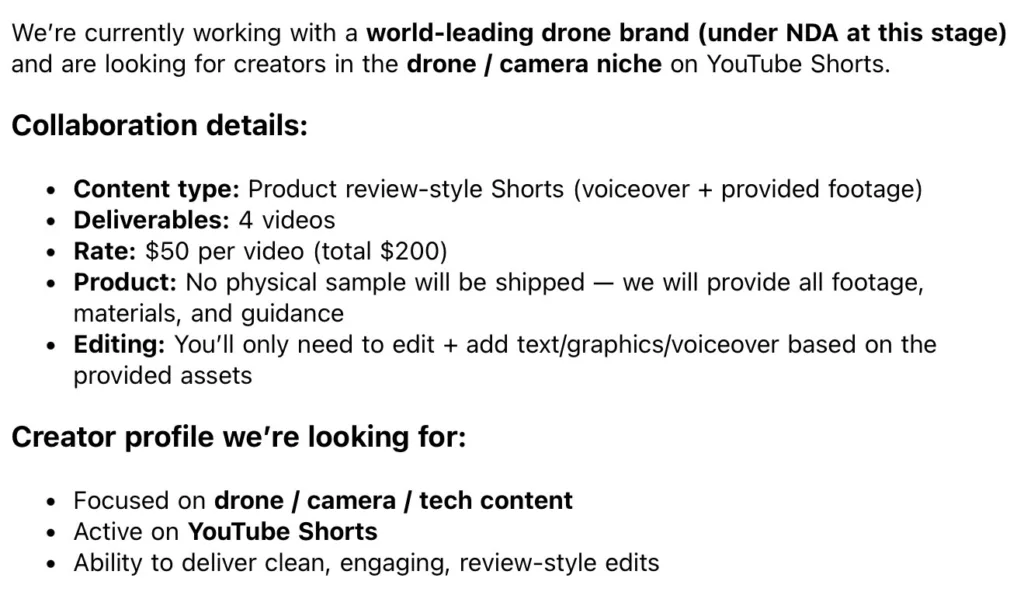
The email sent to content creators on YouTube specifically notes working with a world-leading drone brand to produce “product review-style shorts” where no sample of the product will be shipped. Content creators would be provided the footage and assets, with the creator able “to deliver clean, engaging, review-style edits”.
Creators who did this only need to be able to make edits adding text, graphics, and voiceovers, and they’ll be provided $50 per video at a total of $200. The email doesn’t suggest what currency, so let’s assume $200 USD for four review-style videos conducted without the product.
Here’s the thing about product reviewing: all that stuff I mentioned before about being a full-time job doing these things hasn’t changed.
When you’re a product reviewer, you still take the product out, test it, integrate it in your life, find ways to push it, to ask questions of it, typically apply it to a methodology, and then deliver the review. That is how product journalism works, and while styles can vary, any suggestion that it doesn’t or shouldn’t involve a product is outright charlatan journalism.
Call it what it is: an ad.

Why this is a problem
The problem with all of this is the trust in product journalism is in a constant state of flux with readers and viewers and listeners entirely.
When I started nearly 20 years ago, people would regularly assert that companies had paid me to say certain things. How dare I suggest a product that was good was actually good? Clearly money must have changed hands!
It didn’t. The money that changed hands was my employer paid me to review a product, and to do good journalism. To follow a methodology and investigate whether a product was good or bad.
I’m not the only reviewer who has had to deal with this line. Other reviewers talk about it, and most of us make fun of it actively. We call it out for what it is: nonsense.
But there’s a reason why people believe it: products cost money, and there are people who will say anything for the coin, or might say anything for the promise of it or something like it, such as a trip, products, etc.
In the age of influencers where that seemingly happens more often than it used to, it makes more sense now more than ever to ask that question.
And content like this only makes it worse.
Being truthful matters, because that’s journalism
I’ve been a journalist for nearly 20 years, and while my writing style has changed, hopefully improving, my core approach has always been the same: be honest.
That’s being a journalist. Provide the story with as much honesty to the sides that matter, the angles that are important, and deliver the audience the best damn analysis they can find.
In an age where it seems like publishers are all but giving up and looking for the easiest money-making solution (ads), I think that’s a rarity.
Even though it requires me to work a full-time job alongside being a journalist, I am still out there delivering, winning awards, changing how online reviews are read, and appearing on radio (ten this week alone) helping people.
The truth matters. If you’re going to review a product, it’s the entire point.
Audiences expect it. They demand it. Anything less is charlatan journalism, and needs to be called out, plain and simple.