
After being a reviewer for near 20 years, I can tell you a thing about reviewing.
Product reviews need a structure, and they should have a reason to exist. It’s an often friendly and conversational analysis that plays out like a story, using details, data, experience, and expertise to relay that story in a way the reader can trust.
The problem is that aspects of can simply feel like data, and aren’t easy to understand by readers.
Take benchmarks, a source of data that is on the whole a synthetic way to convey how a product is faster or slower than it should be.
Good benchmark data typically shows something comparatively: is this device faster than another model, and is the battery life longer or lesser? It’s supposed to tell a part of the story in a way that’s hopefully relatable, and is often why benchmarks include multiple devices in them: this device is faster than that one, but slower than another.
The problem with this data is it’s not always relatable to readers. If they don’t have a device in the benchmark, it’s just another synthetic guess: the new device they’re reading about is different from another. Helpful, but only to a degree.
Every site does this, even this one. It’s not a bad thing. It’s just the industry, which came out of magazine reviews, shuffled to online, and really didn’t give the concept of benchmarks a second thought.
Here at Pickr, I’ve decided this year (2026) is a year of change, and so I decided to look at the humble benchmark. Is there a way to improve it? Can it be easier to relate to?
For the past five or six years, Pickr reviews have collected a lot of data using our reviews methodology. It’s why our reviews can be trusted, and aren’t just experience, but based on data. We’ve shown that data using a fantastic visualisation service called Datawrapper, but for the past year, I’ve wanted to try something else.
This year, Pickr adds its own proprietary data visualisation approach to the mix, and it’s one I’m really proud of.
The system not only lets reviews compile benchmarks quickly and easily, but it also introduces a world first feature no other website has (that we can find): personalised benchmarks.
What is a personalised benchmark?
Let’s say you’re in the market for a new phone, and you want to check out the latest iPhone. You might have found your way to a review from a simple Google search, a guide to the range of iPhones, or even using Pickr’s game-changing Helpr tool that chooses the good, better, and best products for us to read reviews on.
Regardless of how you landed at a review, you’re there and learning about a product, its design, features, and so on.
Eventually you get to performance, and the obvious benchmarks. They’re telling a story, but you have a different phone than what’s there, so it’s difficult to relate to.
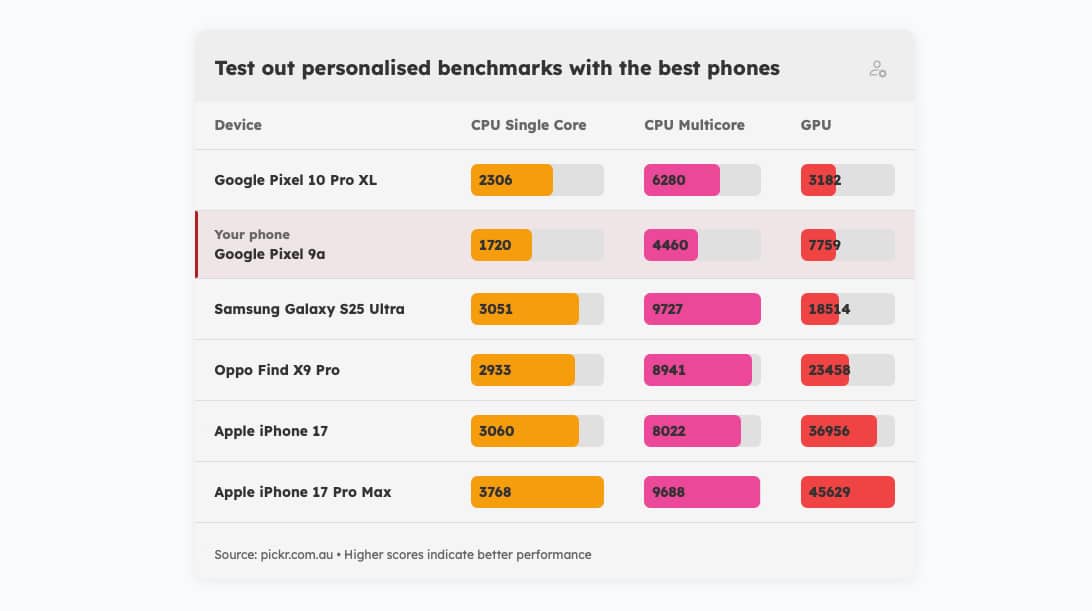
Pickr’s Personalised Benchmark lets you press a button, search for your own phone, and instantly add it to the benchmark, as if the article was published with your phone in the list.
| Device | CPU Single Core | CPU Multicore | GPU |
|---|---|---|---|
|
Google Pixel 10 Pro XL
|
2306
|
6280
|
3182
|
|
Samsung Galaxy S25 Ultra
|
3051
|
9727
|
18514
|
|
Oppo Find X9 Pro
|
2933
|
8941
|
23458
|
|
Apple iPhone 17
|
3060
|
8022
|
36956
|
|
Apple iPhone 17 Pro Max
|
3768
|
9688
|
45629
|
Scroll down to the next benchmark and it’ll be there, too. Your phone has been added to the list, making it more relatable: you know how fast your phone is, and this shows a new phone relative to your device.
It even works between Android and iPhone. While aspects of these devices are often apples and oranges, and there’s more to what makes a phone better than simply system performance, Pickr’s Personalised Benchmarks aim to relate the system spec story in a benchmark rather than simply assume a reader will get it.
And depending on how recent your phone is, it will even work in battery performance benchmarks, as well.
We’ve been reviewing batteries with methodology for a number of years now, but last year we added our own battery benchmarking app made for iOS and Android to the mix, allowing Pickr to have a consistent data-led approach to battery run time. Granted, it means the number of models with battery performance are low at the moment, but that will change, and should show the massive difference in possible battery performance between phone models in the market.
Set and forget
There’s more to a review than simply benchmarks, but benchmarks have remained one of those required elements that has never really been relatable. And now it is.
It even works in a set and forget approach: set your phone once and it will apply to every phone review where the benchmark feature has been applied to, something we’re gradually rolling out to reviews throughout our ten year history (it will likely come to reviews from the past three years). That means when you come back and look at a different review, you might even see what you have (or had), and how it has changed over time.
At the moment, we’ve made this work on phones to begin with, and it works without registration, just like our bookmarking feature, which we rolled out in January alongside the Helpr tool, an AI voice system that doesn’t waste server energy, and a cleaner design and better readability.
Like everything else on the site, this is just another unique feature of Pickr, which includes no ads. Pickr is still Australia’s only award-winning ad-free tech news and reviews website, and now it has something no other website in the world does: personalised benchmarks. Give it a try.